Tuesday, April 11, 2006

TO BE A DUCK

I told you some time ago that if I could be any animal, I would be a duck. I told you that someday I would tell you why.

I do not like where my eyes are. I want eyes at the sides of my head. And I want black eyes the size of small marbles. But what I want most of all is a bill.

I want an orange bill. A bill is what I want, and it must be orange. I want a bill with which to eat and preen. I would let people call my bill “a bill,” but never a beak. Never a beak, or “a hard nose,” “a preening blade,” or “a saw-toothed nibbler.”

My bill will look so fine beneath my small, duck-shaped skull. The best part about billdom is the purposeful expulsion of quacks from it. All the livelong day: expulsing purposeful quacks.

The greatest noise in the kingdom of animals is the quack. It comes from the bill of the duck, and nothing else. The word itself is worth a fortune: quack. It is spelled like it sounds and is savory. I would quack all day. The quack is rich and self-explanatory. Every answer to every question, statement, or quotable quote, would—from me—be a quack.

“How is it, really, being a duck?”

“Quack.”

“What does a woman want?”

“Quack.”

“You know your house payment is due.”

“Quack.”

“Seventy more soldiers died in Iraq.”

“Quack.”

“These are the times that try men’s souls.”

“Quack.”

“Your nostrils are in your bill, evenly distributed.”

“Quack.”

“It’s time to save the planet.”

“Quack.”

“Your bill is not a preening blade.”

“Quack.”

“How much money do you have?”

“Quack.”

“You’re kind of cute.”

“Quack.”

“From your bill are expulsed many and purposeful quacks.”

“Quack-quack.”

“Are you warm and dry?”

“Quack.”

“This pond is drying up.”

“Quack.”

“Quel heur est'il?”

“Quack.”

“Simplify.”

“Quack-quack.”

“I know people at the pellet company.”

“Quack.”

“The sun will blow up in a million and sixty years.”

“Quack-quack.”

I would quack (and quack) all the livelong day.

As I duck, I could do it all. I could and I would do: it all. I would swim and fly and walk. When I wanted to walk, I would walk out of the pond and walk. When I wanted to swim, I would walk into the pond and swim. When I wanted to fly, I would fly out of the pond and fly. Or I would walk out of the pond and fly. Or I would fly out of the pond and walk. Or I would swim out of the pond and walk and fly.

The best part about flying would be landing in the pond. I would coast to the pond and backpedal with my wings to land with a green and foamy splash in the pond. The landing would be soft and nearly silent. Then I would just paddle around like it was nothing to me, which it would be. Unknown, to me, would the wiles of fatigue be. I would take off and land in a foamy splash and paddle the circumference of the pond looking sprightly—a hundred times a day. People would throw me pellets. I would consume pellets like a nibbler. I would land for pellets and walk for the littlest nibble. I would walk on my webbed feet toward the weedy-colored food.

I want webbed feet that are orange. My feet must match my bill. I would invite the masses to touch my marvelous webbing.

“We will throw you pellets if we may touch your webbing.”

“Quack.”

“The webbing is marvelous to touch. No other duck lets us touch it.”

“Quack.”

“You’re kind of cute.”

“Quack.”

“You are such a unique duck.”

“Quack.”

”We want to be you.”

“Quack-Quack.”

The two best parts about being a duck would be 1) the location and placement of my nostrils on my bill, and 2) my willingness and ability to stick my butt in the air out of the water, very high, while the rest of me is underwater searching for food or simply letting people see my orange, webbed feet paddling hard to keep my butt in clear view of everyone while I open my black marble eyes underwater and look through the murkiness at anything I want to, including the people who see my smooth butt so high up in the air, and how the water runs down my smooth butt, and how my legs match my feet that match my bill which works so hard quacking underwater and making bubbles come up until I fly away when I want to at a right sprightly clip.

Oh, to be a duck.

© 2006 by Martin Zender

Saturday, April 08, 2006

LAST LAUGH IN AMISH COUNTRY

I walked 32 miles last Sunday, 21 of it through Amish country. I have a fantasy about Amish women, thanks for asking. I imagine that they are all sexually repressed and ready to blow. All my fantasies are duds, however. When the pin is finally pulled, none of my fantasies ever explode. If you want the truth of a thing, analyze my fantasies and believe the opposite. The truth of this Amish matter, therefore, is that Amish women are happily asexual and ready to weave a blanket.

I passed through a small town, Vicksburg, named after the historic Civil War battle. The town was old enough, I believe, to have known the smell of gunpowder. Walking through, I expected to see General Lee himself galloping out of the morning mist. Hand-painted lettering on one of the wooden buildings said, “D.W. Coburn, Horseshoer.” Coburn, no doubt, fought for the Union. At this early hour, he was probably still in bed.

I sipped some Gatorade from my drinking tube and slapped myself back into the 21st century. Turning a corner out of town and heading north on Gimbly Road, a string of Amish buggies came down a hill toward me at two-hundred yard intervals. If you have never seen such a thing, you should. It’s a postcard on a squeaky iron rack in a sausage-scented restaurant. The sight slapped me back into 1865, only this time I expected John Wilkes Booth to hobble from a barn.

I waved to the occupants of the buggies as they passed. I saw some of their faces. Who were these people? I considered jumping into one of the buggies: “Who are you people?” I would mount the vehicle, nudge open the door, snuggle in beside the happy (?) couple and begin querying them, beginning with the woman.

“Excuse me, ma’am. Are you sexually repressed? Don’t mind me, I’ve just always wondered. Oh, hello sir, yes, thank you for hitting me. I thought you were all pacificists, but I see that another Amish fantasy of mine has failed to detonate. May I have a word with your wife? That hurt, you know. My name is Martin Zender. Hello, ma’am. You are happily asexual, I presume. Is this your blanket?”

But I only waved. One young man wore round glasses and was laughing. The man was laughing. What was he laughing at? What else but me? He and his wife no doubt found humor in my Amish fantasies. Are they that transparent, my fantasies? They must be. The horses clopped toward church, I knew. If the riders were to laugh at all this day, now was the time. Chuckles, at church, get buggy-whipped to the sod, where the pews are screwed in and the hobnailed boots of the congregants scuffle. It was now or never, and here was the opportunity: a stupid-looking walker with hilarious Amish fantasies. Oh, they were laughing at me, all right.

When the last of the buggies passed, the bell of a distant church tolled. It tolled again and again—for me, I knew. It sent a shiver down me. It was now 1837 and the rote of a dark tradition overcame me. I had to get out before General Washington showed up. Or worse, a contingent of the British.

I stopped for a break at an old cemetery and sat down to put my back against the wire fence and eat an orange. A car went by. Then two. Then three. I peeled a sticker from the orange that said, “Sunkist.” Slowly came the world again, the one I had known. Straining, I could no longer hear the church bell, or the clop of a single horse. I got up and stared for a long time, behind me, at the crumbled stones. Beneath these markers, they all lay still. Not a soul laughed. I was humbled and ashamed of myself. They had all once heard the bell that had tolled so recently for me. I strained in my mind’s eye to see the Amishman again. I would not be so rude this time. I would bow, courteously, to his beautiful wife. He was laughing at me, yes—at me and my time.

To some, there is no time, and these are the Amish, the church bells, and the citizens of the grave.

And the only ones of these three able to laugh, do so.

© 2006 by Martin Zender

Wednesday, April 05, 2006

A BROTHERHOOD OF CREEPIES

I used the money from my tax refund to order the Hennessy hammock. What a day it will be when the Hennessy arrives. I’ll be waiting for the UPS man like I used to wait for the mailman when I ordered X-Ray glasses from comic books and the “super magnifying” telescope from Cap’n Crunch cereal.

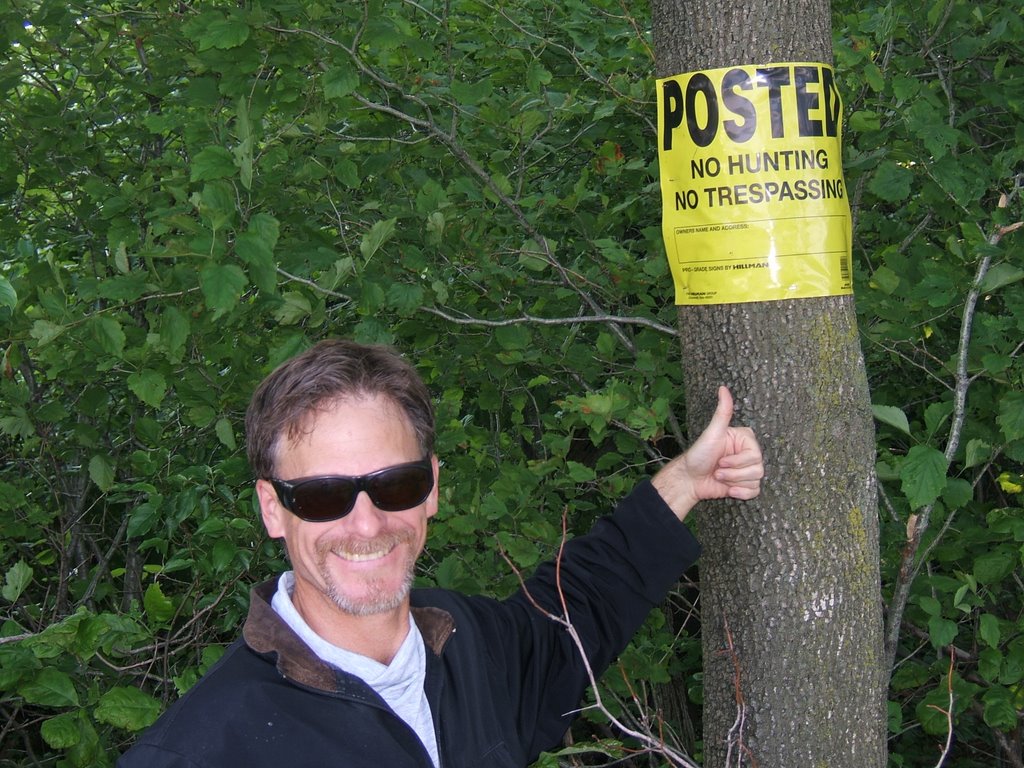
The idea of stealth camping is growing on me. I like the idea of never again paying twenty bucks at a crowded, noisy campground for the privilege of leasing patches of sod infested with sticks and rocks. On my daily eight-mile walks I see beautiful woods with straight, tall trees that I would rate as highly hammockable. I pretend that I am coming upon them on my walk to Pittsburgh. But there are large yellow signs on many of the trees in front of some of these woods, and these signs say, NO HUNTING, NO TRESPASSING. I ask myself what I will think when I see signs like these on the walk to Pittsburgh. I answer myself: I will think, thank God that I will not be bothered by either hunters or trespassers this evening.

At first, the thought of sneaking into a woods at dusk to spend the night alone hanging between two trees creeped me out. But then I realized that I was on the good end of the Creep Factor. I will be the creepy one. It has been my theory since embarking upon self-propelled adventure thirty-three years ago that creepy people leave other creepy people alone. We creepies are a brotherhood, you see. We only creep other people out, never ourselves. We creep out people who live the whole of their lives avoiding creephood at all cost. (This includes most people.)

I plan, on the Pittsburgh walk, to enter the woods at dusk and vacate before dawn. Let’s say there is a person walking down a country road in Pennsylvania at 5:30 a.m. Suddenly, the person hears something large wandering out of the woods, and that something is clearing its throat. Now, which phantom of the dawn will be wetting pants, the one on the road, or the one emerging from the woods?

On one of my eight-mile training walks last week, I walked into a woods off Route 9. I’d had my eye on this tract for weeks, pegging it as a good one to hang in for practice. I had yet to order my hammock, but I wanted to scout this potential campsite in broad daylight, just to see what would happen. I wanted to pretend to be on the Pittsburgh walk, just to see how it would feel to duck into a cluster of someone else’s trees.

The nearest house was three hundred yards away. I waited for a lull in the traffic, then walked in. I went in twenty-five yards, found two beautiful trees spaced perfectly apart, and stood there. There were no alarms, no dogs, no cops. Holy cow, I said to myself, this will be easier than I thought. I pretended to tie my hammock to the trees. The woods felt so peaceful; cars swished by on the highway; I took a leisurely leak. I watched the drivers’ heads through the trees, to see if any were looking at my leak. None of them looked at the leak, not one. Why would they? “Oh. Harold. I’m going to check all the woods between here and Broomsfield to see if there might be anyone hammocking in them—or possibly leaking.”

I was good to go in more ways than one.

My only other concern was the critters of the woodlands. I like animals, but I do not want eaten by one. In this part of the country, however, there are few man-eating beasts afoot. There are, however, beasts that walk through the woods at night and make twigs snap. They scurry and forage and snap twigs, these beasts, and I do not want to hear them. Of course it’s a deer or a possum or a raccoon—but what if it isn’t?

My son Jefferson and I were in the car one evening when the car started making a strange noise. “What’s that noise, Dad?” asked Jefferson.

“I have no idea, son,” I said. “You may as well be asking me for the secret of the universe. But actually, I do know the secret of the universe. But cars and engines? Sorry.”

Still, I could not let the opportunity pass to offer fatherly wisdom to my son. “Whenever your car starts making noises, do what I do,” I said.

“What’s that, Dad?”

“Turn up the radio.”

I plan on applying the same principle to the problem of snapping twigs: I will wear the best pair of foam earplugs money can buy.

Everything is now in order, all problems solved. And so, Come quickly, UPS man.

© 2006 by Martin Zender

Tuesday, April 04, 2006

WITH A BUTLER ON THE LADDER AND A PHIPPS IN HAIR

I was driving my thirteen year-old son Jefferson home from baseball practice yesterday when we (I) decided to flick on a classic rock station. On came Led Zeppelin’s Livin’, Lovin’ Maid. Did that ever bring back memories. Naturally, I had to tell Jefferson about the time I lip-synched the song in front of my entire fourth grade class while wearing green and white checkered pants, a yellow shirt, a Daniel Boone vest, saddle shoes, eating a cherry Tootsie Pop—which served as my microphone—and guessing madly at the lyrics. I hope I did not make a mistake confiding this indiscretion to my youngest son. Jefferson left home this morning with a bag tied to a stick slung across his shoulder, so when he returns home (if he does), I will ask him.

The year was 1969. The occasion was a fourth grade lip-synching contest. What sort of manic teacher would conduct such a competition, and for what purpose, I do not know. But now, in a bout of remembrance, I do know. It was the infamous Miss Clouse.

I remember the day Miss Clouse first walked into our classroom. Actually, she ran. She was late, and our first vision of her was of mincing red heels. She had hair that rose above her forehead in a That Girl pompadour. The hair was Harlow gold, however. Lips: Sweet Surprise. Her hands were always cold; she had Rumplestiltskin eyes.

Each student was to bring a record and be prepared to humiliate him or herself to it. Miss Clouse was the Mistress of Lasting Embarrassment and stood ready at the turntable. Today, I hope it was worth it to her. I hope, at least, that her children are unharmed by the events of that unforgettable afternoon.

Classmates before me did acts like The Rhonettes. They lip-synched to singers like Bobby Darrin and The Everly Brothers. One crazy kid did Buddy Holly’s “Peggy Sue.” He wore Buddy Holly-style glasses but he looked ridiculous in them because he weighed two hundred pounds and his head was the size of a Swiss exercise ball. He did the “…Peggy Sue-a-hoo, hoo-hoo-a-hoo-hoo” part, and everyone laughed. Everyone thought it was ridiculous. But no one had seen ridiculous yet.

My aforementioned clothes (the pants, the jacket, the shoes) were not only a part of my act, they were part of my regular school attire. For me, every day was an act.

I had begged my mother to buy me the green and white checkered pants. Something about the pants reflected my soul at the time (it was my Green and White Checked period), and I wished to display that to the world. My mother, however, wanted denim for me. Her idea of normal was blue jeans. This clashed impossibly with my idea of normal, which was green and white checks. My mother said, “Why don’t you want to wear a regular pair of pants like a normal boy?” I answered that normal-boy clothes did not reflect the current state of my soul. Mother had no answer for that, so she bought me the pants. Winning this argument was easy compared to the time I wanted saddle shoes—that battle took time.

“Saddle shoes are for girls,” my mother said.

“Not really,” I said. “I saw a picture of Uncle Jim in saddle shoes. He’s a famous writer and he lives in Hollywood.”

“Your Uncle Jim is strange.”

“What if I’m the artsy type?”

“Then I’ll probably have to take you to a psychiatrist.”

“Oh, look! Here’s a swell pair of saddle shoes. And they have my size!”

My mother bought me the shoes and I became the talk of the class. I was obviously a trend-setter. It was not my fault that no one followed my trends. At least I started conversations. I got people to thinking. Kids actually wanted to be seen with me. I was a ten year-old Happening.

I got the Daniel Boone jacket at the Myers Lake Shopping Plaza. A
men’s clothing store there was giving them away. In fact, they were giving people a quarter to take one. Once again, my poor mother was at my side. I said, “Look, Mother! They’re giving away Daniel Boone jackets! In fact, they’re paying people a quarter to take one. Have you ever seen a sale as crazy as this one? Have you? Look at the cool fringe hanging off the jackets! I sure wish I had one of those. I could settle Kentucky in one of those things. Can you imagine how I would look in that Daniel Boone jacket and my checkered pants, and my saddle shoes? Why are you stopping? Mother, are you getting dizzy? Look! That man is handing us a quarter!”

The shirt I procured later was the color of the Beatles’ submarine, only yellower.

The Swiss ball kid sat down to resume his life of doom, and it was my turn. Miss Clouse dropped the needle on my 45, and I was off to another world. It was a good world. I liked the world.

Most of my classmates still remember my performance. For some, it was a pivotal moment in their lives. One has since said, “Martin, when I saw you do Livin’, Lovin Maid, it opened doors for me. I realized then that anything was possible. You were outside yourself; it was like you had no self-consciousness, none at all. None of the things that normally hold people back affected you that day. And you kept eating that sucker! It was the way you ate it. And how you licked it like a lunatic at the end when Robert Plant does that crazy thing with the ‘L’s.’” My friend got teary. “You changed my life, man.”

But it was another boy who gave me the “thumbs up,” through the glass, as I sat alone in the principal’s office.

© 2006 by Martin Zender

Saturday, April 01, 2006

CURLICUES OF A WICKED EON

My oldest son Artie and I went out this late afternoon to film depressing scenes for an edition of ZenderFilms. Depressing scenes are so easy to come by here. All one need do, really, is aim the camera any old where and press the record button. But Artie and I wanted to create something. He is a filmmaker, I am writer; we would put our heads together—and probably get them wet: it was raining.

Have I told you about ZenderFilms? Looking back now, I see that I haven’t. I want to create a series of video vignettes that will teach small but monumental kernels of scriptural truth. I’m talking eight to ten minute episodes in the reality television vein.

One of the pieces I have in mind is a series of depressing, outdoor shots, accompanied by a somber voiceover (mine) describing the nature of this current wicked eon. Evolution? No, my friends. The earth is in a state of de-volution, and so many things in this world conspire to take us down with them. The piece will teach the futility of certain brands of human escape, while heralding the benefit of others, such as sleep. Eight hours of sleep, you know, is a pearl of great price to me, and one of the most gracious gifts bestowed by God upon the sons and daughters of humanity.

My son is a serious filmmaker and has invested in a $3,500 video camera. He was afraid of getting it wet, so insisted I take an umbrella and hold it over him while he shot. I was happy to do it. I loved this idea of us being a film crew. It was only him and me, but that counted as a crew to me. Off we went to make something out of nothing.

The process of creation thrills me. I was born to create; God planted a small piece of godhood in my breast. To make an abstraction concrete touches sensitive chords beneath my rib cage. The artist has a thought, or a dream, or a lesson to teach. He or she perceives, in one moment, a sliver of universal truth. But, like the primordial earth, it is without form and void. It is invisible. This light of revelation exists only in the head or the heart or the soul of the one chosen by God to articulate it. The things exist now only in the way the artist’s hand shakes, or in the way the heart beats, or in the way the artist sees light where no light is, or shadows where light washes everything.

The challenge and the torture of the artist is the God-imposed necessity to bring forth into concrete existence the abstract thought. Even God records truth for human consumption. Truth, to be appreciated, needs seen, or heard, or read, or touched. God mercifully provides the media. This media is dug from quarries, or mined, or ground into pigments, or stripped from the bark of trees, or fashioned into hollow pieces of wood. If the artist is a sculptor and the medium is marble or clay, the truth takes three-dimensions. If the artist is a musician and the medium is music, the truth speaks via certain notes played a certain way in a certain order at a certain time. The art not only resides in the notes, but in the inspired spaces between them. A piano keyboard articulates one truth, a violin another, a human voice yet another. If the artist is a painter or photographer, he or she captures a moment of time with pigment, with color drawn from the earth’s native hues, or with light on loan from the sun. The filmmaker captures moving images. The writer places letters side-by-side, in the right order, at the right time, cajoling the letters, belaboring them, marching them en masse toward a desired effect.

As we set out, I felt large. Artie and I were gods. Yes. Small ‘g’ gods, enabled by the capital “G” God, graced with a mood-capturing medium, energized by the goal of bringing His light to the world. What was this but a fresh crack at Eden? It was a means of rectifying the temporary desecration of man.

We began at a place on my walking route where a county crew hacked away at a new bridge. It was Saturday afternoon, however, and the crew was gone. But there was plenty of mud, plenty of grease-soaked chains, plenty of brown watergurgles running nowhere.

Near the site, a trio of gray gain silos rose above a farm through the mist and into the gray sky. “Let’s get that,” I told Artie, and we hopped from the car. I extended the umbrella while Artie’s medium recorded an eonian moment headed for the past. The silence was somber and holy. The silos and the silence, and my son and I—these things impressed me. God was teaching me a lesson about the wicked eon.

We filmed odd tree branches, some weeds, and some slabs of concrete from the unfinished bridge. It was growing dark. Satisfied with our work, we headed home. On the way down our road, the property of a neighbor suggested itself.

“Stop here,” I said to Artie. “Let’s get that.”

“They’re our neighbors,” he said. “What if they see us?”

I had to think about that one.

“We’ll tell them, ‘Please excuse us. We are filmmakers looking for depressing, broken-down garbage typical of an evil eon, and your property provided us a cornucopia of opportunity.’”

Artie laughed. I laughed. We took three shots and drove the short distance home. Melody had hot chocolate on the stove. The curling swirls of steam rising from the pan of chocolate spoke a new language. It was a new form of art I had not considered before. I stared at it. The steam went to heaven in curlicues, then disappeared.

It went to heaven in curlicues, then disappeared.

© 2006 by Martin Zender

Thursday, March 30, 2006

SHAMEFUL WEALTH

I still cannot get over the fact that, when I turn a little knob in my kitchen, water comes out a pipe. The strange thing is that the water gets magically drawn from a well beneath the ground, and it comes up. People in the know tell me it has something to do with a pump, but I don’t care for the details; spare me them, please. I only care that I am in awe of water that comes up from a pipe and into my home when I want it to.

Historically, it was not always this way. There was a day when people had to travel with buckets to a community well, draw, take the sloshing container home, pour it into a cistern, then return to the well maybe sixteen more times, depending on how often the family planned to run the dishwasher. People bathed in rivers back then as well—which reminds me!

There is a miraculous little cubicle in my upstairs bathroom, enclosed by a curtain, containing a nozzle such as the one in my kitchen, only bigger and higher—situated over my head. The nozzle is unique in that someone has drilled lots of little holes into it. But you haven’t heard anything yet. There are two knobs in this cubicle, same as in the kitchen, and when I turn the left knob to the left, hot water comes from the nozzle. Hot water! Hot water with which I bathe! People in the know tell me that this has something to do with a water heater and, once again, a pump. But once again, I do not care to hear about it. It’s a miracle, and that’s the end of it.

Do you realize that, in days not long past, not even the palaces of kings contained such amenities? But if I told you of all the other luxuries in my home, you would blush. It is nearly sinful, what I possess.

My family is spared the trouble of gathering bits of wood to light fires under black stinky pots for cooking purposes. That’s right. Instead—are you ready for this?—we have a flat area on our countertop that, when other little knobs similar to those which operate the water are turned, make various parts of the countertop heat up. And the heated parts light up in the exact shapes of the bottoms of our pans. And the heat is hot enough to cook on!

I can no longer be quiet about any of this; I am too aroused by it all. Concerning physical, tangible blessings, Scripture says that with food and shelter we should be sufficed. So you can see that, even with the little I have told you about, I am blessed above and beyond measure. I will say no more. For if I told you of the means by which I answer nature’s call—indoors—and evacuate it from the premises—you would simply not believe me. You would hate me.

I am too ashamed of my wealth to tell you about it.

© 2006 by Martin Zender

Wednesday, March 29, 2006

EFFECTIVE CURES FOR DEPRESSED WOMEN

And now, naturally, I am being asked by the women how they might cure their depression. It is amazing to me that women experience such a thing. It is like learning that the butterfly despairs of the magic flying powder dusted by God on its wings. I know, of course, that women are depressed. Married women are depressed because they live with careless, sleepy men. Some women feel they don’t have a purpose in life. Others are certain that the endless details of maintaining life will soon kill them. Women are multi-taskers, but they take it too far. I understand why, though: no one helps them. But just because a person can do everything, doesn’t mean a person should.

As a short-term fix, the woman who is at least well enough to leave the house should do so immediately, and take a friend. If she cannot find a friend, the Hershey Company provides them, wrapped in silver foil. That is correct. The first thing the depressed woman must do, with or without a human companion, is buy and eat lots of dark chocolate. This will take the edge off her immediate pain. You see? I do not give the same advice to the women as to the men. It does not help women to log onto the Internet and look at pictures of men in boxer shorts, even if such sites existed. There are no such sites for women on the entire World Wide Web, and neither should there be. There are several sites for chocolate, however, and for good reason.

Upon ingestion, dark chocolate improves the mood. It also releases hormones that simulate intimate dinners for two at fancy restaurants. It also unleashes boatloads of antioxidants that do mean but necessary things to boatloads of oxidants. It also slathers the soul with incredibly warm sensations; it smooshes in the mouth and makes the breadth of the oral cavity feel creamy. It doesn’t simply go down the throat, it flows down it like a dark, sweet waterfall. Hard chocolate crunches in the mouth (it feels good to the teeth), while soft chocolate melts there, enrapturing the tongue.

Next, the woman should go shopping. If she has any money left over after the chocolatefest, she should buy herself a new article of clothing. If she has no money left, she should at least feel the new clothing. Shopping does not necessarily mean buying things. The woman should pet the clothing over and over again (and perhaps rub it against her cheek), then try on new shoes after smelling them.

What if a woman is too depressed to leave the house? This woman should, first of all, comb the house for chocolate. If no chocolate can be found, I recommend sleep. Unconsciousness is a gift of God to both sexes. If one is dead to the world, one cannot be depressed. A further recommendation: close the drapes and engage a large electric fan. Waking up is a bitch, which is the reason for the drapes and the fan. Now, for the long-term solution.

Sigmund Freud stroked and stroked his little white beard trying to understand what women want. He never did figure it out. I figured it out two years ago. All women want is to be adored, appreciated, cherished, even pedastalized. For married women, this begins with the training of a husband, whose days of cherishing, I assume, are long behind him. Ah. What a waste of a good piece of meat: the husband. There is so much potential here for help, work and comfort, all lying dormant before the computer and the television. In a book titled Shagah, I instruct women how to train their men to cherish them, adore them, and help them uncomplainingly around the house. Women will be surprised to learn that men want this training. Though they are usually the last to admit it, husbands want directed by a benign feminine sex force. Shagah offers win-win relief, in the depression department, to both marriage parties. For those who apply its truths, Shagah marks the end of marital misery. Sorry now to have to tell you this, but you will have to wait until either Fall or Spring or Summer for this book.

For the depressed unmarried woman with children, here is my recommendation: Come Fall (or Spring, or Summer), find yourself a good man. (An average man will do.) Buy my book, train him, and live happily ever after. In the meantime, eat dark chocolate, shop in moderation, drink lots of water, sleep eight hours a night, and take long, slow walks every day, no matter what the weather.

For the depressed unmarried woman with no childr—

Hm. As soon as I meet one of these, I will advise.

© 2006 by Martin Zender

Tuesday, March 28, 2006

NUCLEAR WAR AND THE BIKINI CURE MALE DEPRESSION

A single guy I know gets frequently depressed. He lives in Northern Ontario—sorry for the redundancy. He lives where the sun is rarely seen and the roads are so muddied and pot-holed that the local car dealership has three moon rovers on the lot.

This guy was once so depressed that he wanted to kill himself. He called me and fished covertly for an immediate remedy to his mental difficulty. Why did he call me of all Earth’s mortals? I am the great Martin Zender, confidant of God, holder of the keys to people’s happiness. Good thing, then, that I did have a remedy at hand. Some day people may recognize my wisdom and make me their first resort rather than their last. So I said to the man, “Go on the Internet and look at pictures of beautiful women in bikinis. Not pornography, just beautiful women in bikinis.” There was silence on the other side of the line. “The bikini was named after the atoll in the South Pacific where the first atomic bomb was detonated,” I continued into the silence. “When atom bombs are falling, people forget how depressed they are. It happens all the time. Imminent nuclear war and two-piece swimsuits take the male mind from all other problems.”

My friend was taken aback at first, but then warmed to the idea. Oh, but this wasn’t an idea—it was a cure. I told him that my simple solution would relieve him instantly. It would make him want to live again, at least for the rest of the afternoon. It was the free, legal, God-inspired solution to his problem. In some parts of the world, I told him, the sun actually reported for celestial duty. In some parts of the world, I said, beautiful women wore extremely small bathing suits.

He said, “You know, I do feel better when I look at a beautiful woman.”

Well, duh. Do I have to tell you to eat, too? Must I instruct you to bathe? To breathe?

The annual Sports Illustrated Swimsuit expedition embarked upon by my two older sons and me raises the eyebrows of embarrassed/horrified people who may, in their lifetimes, have discussed sex once—with the obstetrician. The embarrassed/horrified people had sex because they have children, but “the dirty part” came and went in the dark and lasted as long as it took to disrobe and disburse seed. And God forgive all parties for what made the seed come out. And God forgive Himself for having invented beauty in the first place.

It is stupid, in my opinion, for fellow testosteronians to pretend among ourselves that we could take or leave the bikini and its inhabitant. The cover of this particular Sports Illustrated is an anomaly in the midst of an evil eon, for it opposes everything we know so far of this damned winter. I praise Jesus for that. To refuse to look at such respite is to spit in the face of God. It is to slap away a reasonably priced escape ladder dangled by the Deity’s celestial helicopter.

I will have no awkward moments with my sons. I refuse to allow into my home the time-tested “ignore sex/screw up your kids” syndrome. I refuse to slip on the divine banana peel (the bikini and its inhabitant) and then pretend that I didn’t. My boys are looking anyway, so why not accompany them, foot the bill and get shrimp out of it? The more normal I make it (and it is so very normal), the less powerful its pull. The bikini and its inhabitant will always pull, but one can diffuse the freak side of the power. Religious people habitually make normal things freakish by silently (or vocally) condemning natural inclinations. This is a recipe for the production of criminals. The criminal starts and may finish in the closet. At worst, he wreaks mayhem among the less religious (and thus, the less peace-loving) citizenry. I prefer a nice quiet trip to Waldenbooks—followed by cheese rolls and shrimp—to abandoned carnal mayhem followed by an i.d. check at the state penitentiary.

Some very ingenious people designed the swimsuits worn by the SI models.

In some other corner of the world, the sun, apparently, has escaped its box.


© 2006 by Martin Zender

Monday, March 27, 2006

HOT SOFT CHEESE ROLLS

My two older boys and I enjoyed our annual Sports Illustrated Swimsuit Issue date last Saturday. On this annual date, I drive them to the mall, buy the magazine, hand it over to them, then drive to Red Lobster while they take turns perusing the pages and not saying much. When we get to Red Lobster, we ordinarily wait forty-five minutes to an hour for a cozy booth in the non-smoking section. This is precisely what happened. The wait only enhances the satiation of hunger. Hot, soft cheese rolls in a wire basket covered with a napkin make mortals lose saliva from the corners of their mouths. Lift the napkin and cheesy heat wafts into the lantern-style light fixture. This is accompanied by iced teas and a black decaf served in a heavy, earthen mug.

While waiting for our table, many odd people filed past us. Some people in this world are beautiful, while others carry extra flesh and are misshapen. Three crippled souls rolled past in wheelchairs, one of whom rolled over Aaron’s foot. One poor chair-bound female stared out toward an invisible ocean and mumbled strange sayings while making wild gestures with her hands. Aaron said, during dinner, “Many people in this world are not right.” Artie said, “We are so blessed.” Aaron agreed with him, as did I.

There are so many different kinds of people in this world, and my sons and I are blessed to know the One Who made them all.

Together then, we thanked God and broke His bread.

© 2006 by Martin Zender

Wednesday, March 22, 2006

NPR ANGEL

If a male angel lived in a heavenly palace and looked into his sleeping cubicle in the morning after returning home from his early session in the clouds to be with his little angel offspring and read Acts to them, and his angelic wife was lying on the bed doing dumbbell bench presses in the nude with an NPR show playing lightly on the radio, then that male angel would know that there will come days better than those gone before (before the disruption of the world), and that it may be one of those today as the winged Being wafted him by God now stretches the hamstrings in the backs of her legs and by some miracle has a celestial sort of side meat already sizzled from the stove and cuddled in a “napkin sandwich” to remove all the hellish earth-grease from it.

“Even so,” says the celestial messenger to a compatriot at the commissary, “come quickly Lord Jesus.”

© 2006 by Martin Zender

Tuesday, March 21, 2006

DAY OF BITTER COMPLAINT

Oh, that my vexations were actually powdered by the pestle, then laid in the grave together with my iniquity. For then it would be heavier than the mantle of the earth and the starfish of the sea and the skeletons of mariners.

My words are rash and quick, for the arrows of the Almighty are inside me with their poison tips in my liver; my spirit quakes at it. The terrors of God are arrayed against me. The jackass brays over his grass and the ox wails mournfully over his meal of bone, but tasteless things go down without salt; the white of an egg bloggs in the bowl. Such food makes loath against days much brighter than this.

Oh, that my request might come to pass, and that Gould would grant the whim of the will; would that God were willing to crush me in a moment; that He would loose His hand and cut me off and break this, and let me get this off. But it is still my consolation that I rejoice in unsparing pain and that, in the lake, I have not denied the words of the Holy One; these are His words.

What is my strength that I should not eat rust and drink poison, and what is my end that I should wait to tiptoe on the inside of grace? Is my strength the strength of granite or is my flesh of silver like the metals that crush miners? Is it that my help is not inside me and that the deliverance of my God will wait another day?

For the despairing man there should be kindness from a braying cloud or a dollop of sun, lest he forsake the fear of the Almighty and suffer the death of another day like this one. My brothers have acted deceitfully, like a dry river in the desert, like the torrents of dry river dust that vanish before they appear and are turbid because of no dew. No person scrapes the dew into snow. But the blessed man sees not the trouble of this Spring, for he has passed along another way, the way of death.

The rivers, for those gone, become more desolate still, more waterless; they become bare and soulless. When it is hot they vanish yet more from the places appointed them. Then the paths of their courses wind along the corridors of deferred hope, they go down into the valleys of hope deferred where they suck and stink and defer everything forsaken by God, where they piss a storm of wail.

The caravans of Tema looked like crap; the travelers of Sheba hoped for crap and got it. But they came there and were blown away by the nothingness of everything they saw there. Indeed, You have now become such as them, this day, save for young men who stand tall like the oaks of Mamre. You see a terror and You soil the pants of people who are not You. It is not as if I have said, “Make me rich,” or, “Offer me a babe from Your storehouse,” or “Deliver me from my organs,” or, “Redeem me from the insipids who deem this life so lightly.”

Teach me and I will be silent and watch Curb Your Enthusiasm; and then show me, after the show, how I have erred. How painful are honest words, and You’ve got an eon’s worth of them. But what do Your honest words prove? Do You intend to reprove my honest words? Then go ahead. You may as well—I like it—I die for it—I like pain—I die. But You know these things already, so what am I telling You?

But why, when the hours of one’s despair disappear on the zephyr of cloud that discourages all the living, do You then not come right away but seven months hence, if at all, and then so lightly? You would roll the dice for the orphans and barter over Your friend. Gore is something You tolerate blatantly, though you have spared me thus far the gore I feed, house and clothe—and for that I worship You. And now, please look at me, and see if I lie to Your face. Because I’ve looked up to You even while tied to the boards of Your threshing floor. And the night continues, and my flesh continues but is clothed with righteousness with skinny worms sewn in, but I am still looking up tied to the threshing floor of Noah, and of the archangels Who created Earth, Who are always all around You.

Desist now, let there be no injustice. Ever desist; my righteousness is yet clumped up. Is there injustice on my tongue? All right then. Cannot my dump-mouth discern calamities and give vent to them in the wind of the first day of the rest of this dung-infested time period?

All right, then. So be it. Amen, and come quickly.

© 2006 by Martin Zender

Monday, March 20, 2006

MELODY WHITE VS. MOE & COMPANY

I did a bad thing last night while Melody was berating Aaron for staring down a teacher. Aaron is a high school Junior, and this particular Mistress of Numbers has something out for him. Or in for him. Or maybe he has something out or in for her. Or maybe math has something out and in for all of us, which is my conviction and has been since Freshman Algebra.

Aaron must take care because he’s working on straight A’s (from seventh grade on), and this teacher needs coddled, not outstared. It is true that she may be lacking in the ways of education, but so what. I had teachers like that, too. I was not so careful with language back then and would come home in a huff to announce, “Miss Clouse stinks.” I’m pretty sure that, between 1966 and 1978, I was perfect and nearly all my teachers, including the nuns, were hopelessly screwed up.

Melody said I should discipline Aaron. That is, she wanted me to tell him how to be a good young man.

Melody grew up on a farm. In such environments, character gets pounded into you like a three-pound pancake. Melody got up before dawn to feed chickens and milk cows. Good young men were as plentiful as sprouts of alfalfa. Melody’s real world was Laura Ingall Wilder’s fiction. As a young man, I loved purity and hard work, as long as I could write mis-rhyming poetry about it from a safe distance. Melody regrets this about me. It is the part of me she wishes she could change. I sometimes tease her and tell her, “Well, maybe you should have married Mike Hartz.”

Mike Hartz was everything a girl could want in a man. He was a stand-up cutout dude from a catalog, replete with polished shoes and a nice haircut. From a practical standpoint, Melody loved everything about Hartz. His goal was to become a History teacher. His life was planned out, right down to the kind of grass he wanted in his yard and the church he and Melody would attend. He would give Melody a three-bedroom house, a two-car garage, and a Lazy Susan in the kitchen. The guy pressed his own pants, for God’s sake. He knew how to wash his car—including the whitewalls.

Because Melody was so darn cute, Hartz wanted her for his own. Who wouldn’t? Melody was so much like him, too. She was willing, in her heart, to succumb to the two-car garage. The problem was, Melody kept calling him “Martin” on their date. (I still wonder why, after going out twice with me, she still went out with Hartz. She told me she was going to do it. “Is that okay?” she asked. “Of course it is,” I said. Then I got off the phone and cried and threw jellybeans.) At the end of the date, Melody refused to let the sex-crazed Hartz kiss her. She told him a week later that she couldn’t get “this other guy” out of her head. Hartz, the ever-practical idiot, said, “You mean I spent all that money on you Saturday for nothing?”)

While Melody built barns, planted trees and baked pies, I watched Three Stooges and Gilligan’s Island re-runs. My parents made sure my sister and I had endless supplies of Popsicles, pop, Pop Tarts, and Sugar Pops cereal to serenade our television watching. My parents did discipline us: sometimes they bought us cereal without sugar and made us watch Jacques Cousteau specials. (I’m talking about cereal like Bran Flakes, Special K and Product 19, and Cousteau specials like the one about plankton.) But my parents loved us. I can’t help it that I grew up in the suburbs. My only knowledge of farm life came from Lisa and Oliver Douglas, and Mr. Haney and Eb, on Green Acres.

I did receive real discipline on occasion. I remember Mother chasing me—and rapidly—with the hairbrush. She did make contact two out of seven times. I did get grounded for innocent childhood crimes such as forgetting to do homework, forgetting to pull weeds, forgetting to clean my “pig sty,” and forgetting to go to bed on time on school nights. (I was a forgetful child. Well, I forgot things.) I remember getting my mouth washed out with soap, and to this day I cannot say what this was frickin’ for, or how I could possibly have deserved such humiliating doses of hell in my own stinking house. Nevertheless, I succumbed to all this parental treatment; I considered it par for the childhood course. Then I grabbed a purple Popsicle and wondered if the next Stooges episode would feature Curly or Shemp. (I hoped it was Curly, but I would learn in my teen years to appreciate the genius of Shemp.)

I’ve always been a do-it-yourself discipliner. With the things that really mattered in life (learning to write, staying fit, reading, obtaining wisdom, caring for family, seeking God), I was harder on myself than others could hope to be on me. Thus, I believe that while you can influence others and set a good example, you cannot live more than one life at a time—your own. This principle is especially true of the relationship between my two oldest sons and me. They are nineteen and seventeen years old. As with my youngest son, I trained them as best I could. I spanked them early with love and intelligence (and a spoon of some kind), I carried them on my back, I hugged them (still do), I got onto floors with them, I read them scripture and many Dr. Seuss accounts. I loved their mother, supported my family, spent every spare minute giving them God, fun, and organic raisins. Now I’m tired, and I believe I deserve a rest. I want to reap now the plentiful fruit of good parenting and shrug off the rare thorn. You can lead a horse to Advanced Algebra, but you can’t make it not stare down a crummy teacher—that’s my philosophy now at this stage of the game.

So right there in the kitchen, in the middle of the berating, I started to laugh. It was the worst thing to do, at the worst time. Poor Melody. That she was so technically right and I was so technically wrong proved too much contrast for my funny bone. It was the farm versus strawberry Pop Tarts, Laura Ingalls Wilder verses Larry Fine, Product 19 versus Kellogg’s’ Fruit Loops, Melody White versus the Marx Brothers. That Melody was so serious while I experienced flashbacks of French class drove me over the back of the sofa in tears. I hated myself. The more I told myself not to laugh, the more I dripped spittle and snot. The healing of it was absolutely horrible. (I realize now, upon reflection, that my laughter was not of the healing variety, but rather a self-defense mechanism against the false accusation that I was somehow, in this case, a poor father.) Aaron just stood there, wondering what would become of his legal guardians. (Our youngest, Jefferson, had run away—in titters no doubt.) Then Aaron had to laugh himself; it was two against one now. You’ve got to feel sorry for poor Melody. She tries so hard to make us good people. God has withheld from her a daughter, a princess, a normal human being. Instead, he gave her Larry, Curly, and Moe. Melody will read this and dislike that I have written about it. If you are reading it, I am wondering how it is possible.

Upon reflection, I know. It is because my wife is the kindest, most forgiving, most well-rounded, well-meaning person on the planet.

Eat your frickin’ heart out, Hartz.

© 2006 by Martin Zender

Saturday, March 18, 2006

ROAD MAN

It is already the following weekend, and I have yet to tell you about my walk of weekend last.

On Sunday the twelfth, I walked 27 miles. It was easy.

I awoke up at 5:00 a.m., excited to begin. It was rainy and dark, but warm. I love the pre-dawn dark because I own the day then. By the time the sun comes up the world is alive—I prefer it sleeping. Jesus rose early, before the sun, and walked into the mountains, alone, to pray. Self-propelled motion becomes a prayer to me, and each step a thanksgiving to God that I am alive.

I lightly boiled my three eggs, sprinkled my oatmeal with ground flaxseed and wheat germ, slugged down a double-strength cup of black coffee, drank four glasses of water, poured two liters of lemon-lime Gatorade into the bladder inside my Camelback Blowfish pack, hung a plastic sandwich-bagged whole wheat, wheat germ, natural peanut butter and honey sandwich from the waist strap of my pack—and was away.

I floated. I walk a nine-mile block: three miles up, one and a half across, three down, then another road across like the first. All the miles, this morning, are floating. Feeling fresh from a day off, I am hydrated like a lake: the key to success.

The rain comes lightly and my raingear works: it’s called Rainshield, the brainchild of the 3M company; Gore-Tex is sievey compared to it; remember that. Inside my hood, I feel indoorsy. The black galoshes keep unwanted roadwater off my socks and out of my shoes. Roosters crow, the rain does not stop them. They are my companions across Crescent Road, these crazy birds. I never see them, but I like what they do when I don’t have to live by them. They cry out of nowhere; I like their language.
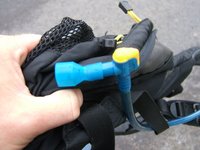
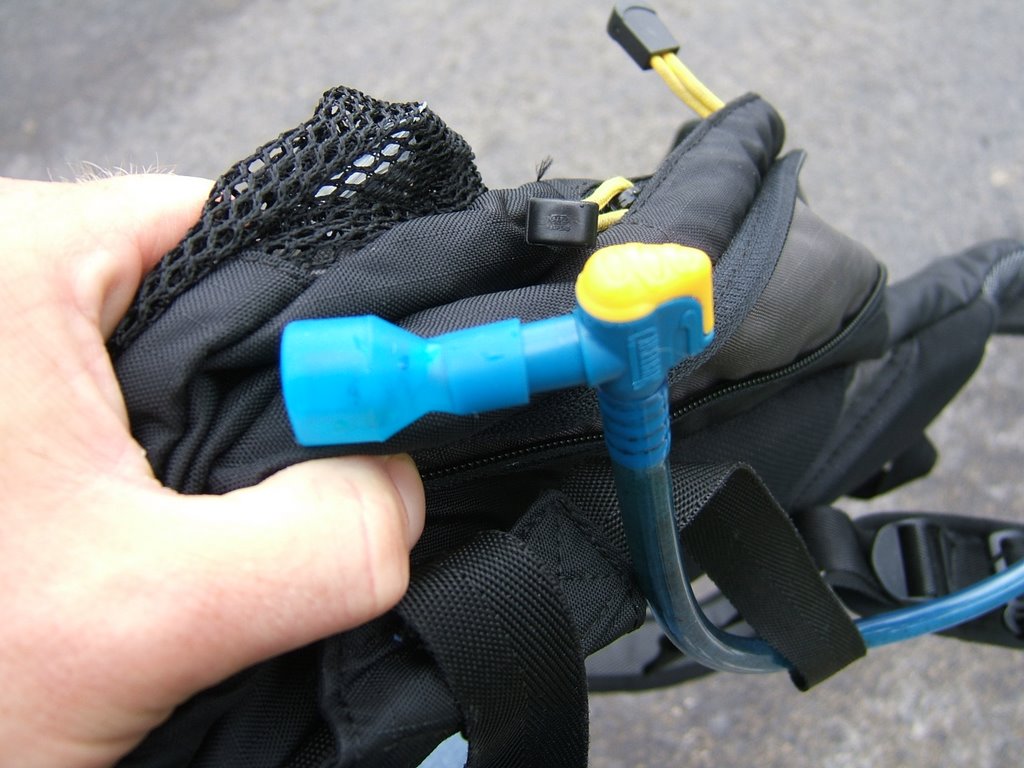
I sip Gatorade through my drinking tube. It is a wonderful thing, this tube. The modern pedestrian need not stop to fumble with old-fashioned bottles. The tube of the bladder is blue, snaking from the back o’ the pack o'er my right shoulder. There is a bite valve, which is blue and yellow; the materials are clear. A marvel of science, all this is. I stick the valve in my mouth and return both arms to their work. I bite the valve and suck. The elixir, still cold from the refrigerator, comes in peristaltic rushes. The elixir is lemon-lime Gatorade, which I imagine to be cotton-candy syrup. I think this in my mind: I am drinking the syrup of cotton candy. Ahh, that is so good—and at the same time it replaces electrolytes and renders the perfect combination of calories, carbs, sugars, water, and sodium, unto my system. Gatorade, the elixir of the gods. Had it been available in first-century Palestine, Jesus would have drank it for sure.

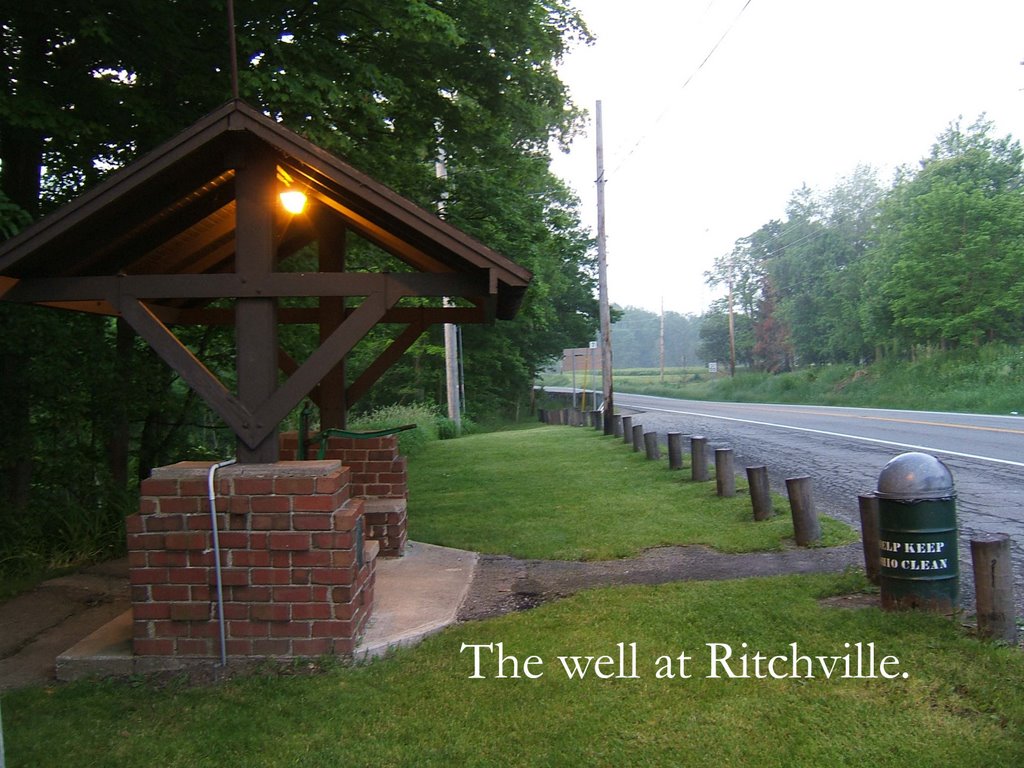
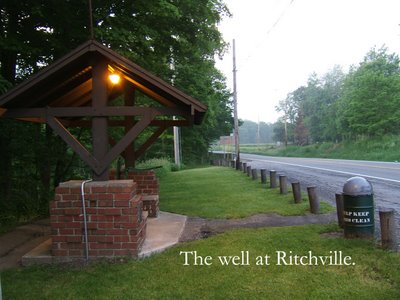
I sit down at a well in Ritchville, same as Christ. This is a drinking place at the Ritchville rest stop, but without loitering women. There is a rusty green-handled crank here instead, protruding from a metal pipe stuck far down into the groundwater. A person toting his own Gatorade, however, eschews such primitive refreshment. So I sit and rest for two minutes, get up and go. It is still dark, thank Jesus.
North up Route 9 now, when I will eat my sandwich. There are not many cars on Sunday morning. I walk on different sides of the road, depending on what the cars do and how loathe I am to die, which is pretty loathy now that I’m happy on the majority of days.

I imagine that my sandwich is a maple-filled creamstick. It is not that I crave such a thing (though I used to, many of them, the icing wet with condensation from the plastic wrapping), but that the sandwich actually tastes like this, to me. I misspoke to say I imagined the taste; I take the taste it gives, which is that of a product of the bakery I just mentioned.

My legs work independently of me, or so it seems. It is so, even at seven miles when turning off the highway onto Snyder Road toward home and the end of the first nine-mile loop. I am my own passenger, sitting atop these amazing appendages with shoes attached, watching them work. They are transporting me—that’s how it feels. I am only looking out the windows, thinking of other things. I am thankful to be whole. (I am thinking of you, Sheryl, who have lost parts of your body to cancer. I am thinking of you this morning; I envision your wheelchair and I want God to give you joys not requiring legs; there are many such joys; I want you to have them; this is my prayer for you.)

The first lap ends, and I’m back home. I stop in to kiss Melody good morning. I make another sandwich, drink four more glasses of water, and top off my drinking bag: another liter of Gatorade. It’s a twenty-minute break in all, then back on the road, and happy to be there.

Starting the second nine-mile loop, I’m as fresh as at five-thirty a.m—how does that happen? The sun has come up (behind clouds, it only brightens things a little), but everything else is fine.

At thirteen miles, I cannot believe the walk will be this easy. At fifteen miles, I think the same again. Seventeen miles arrives, and I’m still waiting on the tiredness. The rain has stopped, and the warm air feels so good. It is so unlike the winter I’ve been walking through on my weekly eight-milers. My training is paying dividends now.

Eighteen miles is in the bag (there is no more Gatorade there, however), and I’m none the worse for it—in fact, I’m better. I’m high. Aaron and Melody are in the living room, and I babble at them. I laugh and say things, but just what things I don’t know. High, am I, on endorphins, inebriated in the afterglow of gentle, extended exercise. (I have walked all eighteen miles in under fifteen minutes a mile. The time, less breaks, is four and a half hours.) All my bones feel greased. Nothing inside me cracks or creaks. I have not worked hard, only walked correctly. There’s a flush to my face. “It’s the Gatorade,” says Aaron.

I go to bed and try to take a nap. My plan: two laps in the morning, nap, attend a birthday party, walk the final nine miles at 4:30 in the afternoon.

Sleep won’t come. Melody’s nightwear hangs on the doorknob. The varying endorphins fight friendly brawls within me, utilizing armholds and legholds never before seen. The covers of the bed shroud all this, and keep it humid and loose, away from other mortals. Perhaps this is what life in the womb was like, when outside sounds came muted through the membranes.

Two of the boys’ cousins turned certain ages over and under ten—can’t remember which or for whom—but my sister-in-law Mindy made a fabulous red soup containing vegetables and pasta pieces that resembled stars. I eat two bowls, drink coffee, and look forward to the four-thirty lap. How will it feel? It has been twenty years since I have covered so much distance on foot.

It’s crazy. I’m as fresh at 4:30 p.m. as I was when beginning at 5:30 a.m. When will it hit? The sun finally shows itself (it’s 5:30 p.m. now), and sets everything east of it aglow. I’m thankful for the sun, but not for the people. There are people out now, in their yards and in their cars. They are strangers to me and I cannot fellowship with them. But one man waves, and I wave back. I liked it better in the morning, though, in the rain. I owned the road then, and the roosters were mine. But now I’m a part of everything; I guess that’s okay if one embraces the everything.

Stopping again at the well, everything looks different. Was this the same drilled hole of thirteen hours ago? It has an altered personality now, it’s less mindful of me. I am not as fond of it, and I leave it within two minutes of arriving at it; I have walked twenty-three miles.

At twenty-five miles, the feet finally feel something. That, and a small twitch goes up my right hip. These things are nothing, really. I’m still moving easily. It does not seem like work.

My house has come now, and I stop in front of it. My wife is in there, and so are all my kids. I’m happy that they give me this freedom—to be apart from them and with them simultaneously. Home is a joyful place when one has been away at wells, and fellowshipping with roosters and people who wave. The roosters are fine, the well does its work, the waver tends to his yard, but there is no place like the space in front of one’s own refrigerator, and near the drawer where Melody stores the amazing zip-locked sandwich bags, recently purchased by the family patriarch.

© 2006 by Martin Zender
Friday, March 17, 2006

ST. PATRICK’S DUH

I love Irish people. Some of my best friends are Irish. God bless the Irish and their homeland, Ireland. Lucky Charms is the best concoction of oats and sugar ever poured into wax paper bags and sealed into colorful cardboard boxes with plastic prizes at the bottom, wrapped in cellophane. But St. Patrick’s Day is the most asinine holiday on the calendar.

Any true Irish person—any noble Irish person—distances him or herself from this absurd day. It is named after a person who, at sixteen years of age, got carried away from his homeland, Britain, by Irish marauders. He passed his captivity as a herdsman near a mountain called Slemish. He saw visions (uh-oh) in which he was urged to escape to the north coast of Gaul and become an ordained deacon (double uh-oh). The encyclopedia does not say who spoke to him in the vision, but one can only assume that it was a leprechaun.

leprechaun (lep re kon), n. Irish Folklore. A pygmy, sprite, or goblin.

ST. PATRICK: What are you?

LEPRECHAUN: I am a pygmy and a goblin, but you can call me a sprite. Yes, I prefer that. A sprite, if you please.

ST. PATRICK: What do you want me to do—sprite?

LEPRECHAUN: I want you to escape to the north coast of Gaul and become an ordained deacon. Become learned in the ways of institutional religion. And don’t forget to condemn people and look for relics.

ST. PATRICK: At once, Sprite! Is that all?

LEPRECHAUN: (becoming furious) Well, of course not! I want you to begin experimenting with compressed marshmallows and geometric figures!

ST. PATRICK: Yes, my Lord!

LEPRECHAUN: Yes, my Sprite!

ST. PATRICK: Forgive me, my Lord!

According to the encyclopedia, “[St. Patrick’s] use of the shamrock as an illustration of the Trinity led to its being regarded as the national Irish symbol. A strange chant of his, called the Lorica, is preserved in the Liber Huynorum.” That the Trinity is a false doctrine unknown to Scripture makes me wish for the shamrock a more noble beginning. (Fun game you can play at home: Guess the root word of “shamrock.”) Can’t we just say it illustrates the number o’ people able to make sense o’ St. Patrick’s Day?

Speaking o’ o’, without this famous contraction in “the luck o’ the Irish,” we are left with: “the luck of the Irish,” which is too literal, too sad, and too untrue for anyone’s palate. The Irish are no luckier than any other peoples. In fact, if the Great Potato Famine and the long history of bloodshed mean aught, the Irish are unluckier than most. This contraction, ‘o, is paramount to the furtherance of the Irish myth. It’s the grammatical equivalent of pixie dust. Anything becomes possible when you drop an “f” and apply yourself stupendously at the pub.

Which must be how the famous Blarney Stone came about. At Blarney Castle in the town of Blarney in County Cork, Ireland, is an inscribed slab. No ordinary slab, this. Did you not hear? I said it was inscribed. Are you still not in awe of it? Then I unsheathe my ace: It is “near the top of one of the walls.” (!) According to legend, one who kisses this stone is thereupon endowed with the gift of eloquence and persuasive flattery. This answers, for me, a mystery. Whoever convinced our government to calendarize St. Patrick’s Day and make Irish and non-Irish people alike wear green clothes and send each other hokey cards, must have smooched that rock smooth.

My youngest son came home from school today and said there was a new tradition: anyone not wearing green became susceptible to a pinch. “A pinch where?” I asked.

He said, “Anywhere.”

I apprised his clothing. “You’re not wearing any green. Did they pinch you?”

He said, “I’ve got it covered, Dad,” and he unveiled the tops of his boxer shorts, which were covered with palm trees.

“Happy St. Patrick’s Day,” I said.

“And the same to you, Pops.”

© 2006 by Martin Zender

Thursday, March 16, 2006

IN LOVE WITH MYSELF

A practical example of what I wrote yesterday came to the fore in the kitchen this morning. Melody asked if I got sandwich bags at the grocery store. I said, “No, I forgot. I got them for my office, but not for the house.” Then I decided to add, “I was looking out for Numero Uno.”

I’ve said that to my family more than once. I’m half joking. I’m not sure they get me, and I don’t strain to explain myself. My actions speak louder than my words to them, I think. My family knows that I give them everything. I have given my soul to them and thrown my last literal dollar toward their welfare. And yet when it is obvious to them that I’ve done something for the Z-Man first, I play it. I play the part of the quintessential cad and chant the mantra of the eon: “Looking out for Number One.”

And yet it’s a scriptural concept: “Love others according as you love yourself.” If you do not love yourself first, you cannot love others. If you do not take care of yourself first, you cannot take care of others. Loving and taking care of oneself is not an end (that’s the world’s concept) but a means to an end, namely, doing the same thing for others.

Not many people grasp this. In the interest of “selflessness,” people lose their peace, their minds, their spouses, their kids. By working tireless for others at the expense of their own happiness, the so-called “superperson” harms instead of heals. When you have too much to do and not enough time for it, you yell. When you desperately need rest but never get to bed on time, you cry. When your own health fails because you live for the health of others, you die. Screamers, weepers and dead people—these we do not need. Might I suggest: 1) disappoint at least three non-family members four times a week, 2) go to bed before nine thirty on a nightly basis, and 3) rise before the sun and take a long walk.

When the sun comes up, then for God’s sake, 4) buy sandwich bags.

© 2006 by Martin Zender

Wednesday, March 15, 2006

PASTOR DISASTER

Life goes on, even for non-pastor types. Remind me to tell you sometime about why I am a teacher and evangelist and not a pastor.

Very well, then. I’ll do it now.

God gives different gifts to those in the ecclesia. Some are pastors, some are teachers, some are evangelists, some are jerks, and so forth. I am a teacher and an evangelist, but not a pastor. I have checked all my bones, and not one of them is a pastor bone.

The word pastor, in Greek, is poimen, and it means, “shepherd.” A shepherd is one who tends sheep. A shepherd has to hang around sheep all day and all night. He has to lead, feed, water and guard the sheep. He is burdened daily and nightly with the care of the sheep. Don’t take this the wrong way, but I do not have it in me to guard, feed (literally feed, with food) or water you. It is all I can do to guard, feed and water my family. I water them well because I bought a Culligan reverse osmosis water filter for our home. But I cannot buy a Culligan reverse osmosis filter for your home. I can’t even say, “I wish I could, but I can’t,” because I do not even wish I could. It is simply not in me to stretch myself this thin. I do hope you get one of these filters, though—I do. I want you to have good water, but I shall not be concerned and burdened by the thought. I simply cannot afford to lose sleep over your water condition. But do look into the Culligan filter, not for my sake, but for yours.

I’m too tired to lead you. To lead you, I might have to stay up past 8:30 p.m., which I am unwilling to do. To feed you, I would have to go to the grocery store yet again, which I already go to about three or four times a day because the four other members in my immediate family need different things, all at different times. It’s all I can do to keep my own family in milk. Everyone drinks different kinds. And they all run out at irregular intervals. If I screw up this milk situation, then I’ve really blown it in life, and I don’t want to do that.

I thank God that I’m not a pastor. Lots of pastors I know neglect their own families. The fact that so many pastors do this makes me think that the people are not really pastors. If they were really pastors, God would give them supernatural ability to care for their families first, then shepherd the people of God later. Real pastors must be able to survive on scant sleep. That isn’t me; I get up at 4:30, but I go to bed at half past eight. I do okay on seven hours, but anything less makes me want to nap or die. Real pastors must have broad shoulders and sturdy backs. That isn’t me; I do do resistance training to build my deltoids and latissimus dorsi, but this is so I will feel good and look sexy, not so that I can shepherd you and your kin. I’m sorry. Please don’t take that personally.

I do feel the burdens of the world, but in an impersonal way. I weep for the miserable occupants of this planet, I do. Disasters tear me up. When I read in the newspaper of a fatal car accident, I’m troubled. I can mourn for days over people I don’t even know. I weep for the race, but this does not necessarily make me send a card.

I do not cook spaghetti for the sick. Maybe I should. I thank God that not everyone is like me. Thank you, God and Jesus, that so many people do not think like the person I have become. If I was in the hospital, I would want spaghetti cooked for me. (No meatballs, please, just plenty of marinara sauce.) Perhaps this is real lack on my part. Maybe there is something wrong with me. I’m willing to admit that there is. Or maybe it’s simply that I’m not the pastor type—I am much more willing to admit to that.

I pray for people constantly, but with inarticulate groanings rather than with formulated words. Whether this helps people or not, I don’t know. I suppose it does, only because the spirit is praying instead of me. I do formulate words on occasion, but not that often. When people are on my mind in a general way, then I consider that praying for them. People say, “Pray for so-and-so,” and I say “Surely, I will,” and then I’ll think about that person for about thirty seconds or so, and count that as praying for them. After that, the spirit takes over. The apostle James would scold me for this because he says what good is it to pray for people if you don’t bring them warm mittens in the winter? I believe I’m paraphrasing the man. Well, if you really need mittens, I’ll send them to you. If someone approached me and severely needed mittens, I would surely render the mittens. I am a decent human being that way.

I heard another teacher, Ray Prinzing, tell a parable of the torrentially running river and the ocean. He said that the torrentially running river isn’t much practical good because you can’t put a boat on it, you can’t fish from it, you can’t swim in it, and so it goes. But the river is doing something, that is, it’s rushing to the ocean. In fact, it’s rushing because of the ocean. When the water of the river gets to the ocean, it can bear the greatest of seafaring vessels. Ray said that he was like the roiling water of the river, rushing to get to God. Not much practical good now, but just wait.

The sooner I get into God, the sooner I’ll be able to make James happy.

I still do some good now. People get blessed by my writing and speaking. Teaching suits me because I can drop a truth and run. Instead of giving you fish and giving you fish and trying to hook you another big fish, I can hand you a pole and go home. I give you principles. I make tapes or CD’s, or I write things, then I go away; I love doing this. It’s a fantastic method for me because you can learn about God from my pen or my voice while I’m home sleeping, or eating spaghetti at the hospital.

It takes special skills to pastor, but also to teach. The teacher must be able to ignore people and not consider their feelings. This is hard for some people to do. Some people never can learn it. My wife, for instance (God bless her) can neither do nor learn it.

I am willing to help people, but I like for people to be able to help themselves. I love to be appreciated and complimented, as long as no one asks me to pastor or boil pasta. I love to be hugged and kissed, but all within reason. (Melody is the exception to this rule, of course, and for this very reason I am considering shaving my facial hair. Melody pulled out a dish brush the other day and scrubbed my lips with it and said, “How do you like kissing that?” And I said, “Well, it didn’t feel very good, but I am becoming emotionally attached to the brush.”

I told Melody that I would shave off my facial hair, if it meant that I could begin kissing her unreasonably. Melody said, “But I love how you look with it.” Sigh. What am I to do? This is another topic entirely, so I will forgo it for now. But do you see? I can’t stop talking about my situation. I would make a lousy pastor, due to this. Pastors must talk incessantly about you. I do want to help you with your situation, but I can do that best by writing books for you, and talking to all of you at the same time on a tape or a CD. In this way, ZenderTalk works for me. It works better for me than visiting each of you individually, buying each of you a water filter, or constantly running to the grocery on your behalf, or fending off your many kisses with my bristly face.)

In all this I am trying to justify myself for not visiting the nursing home to see Herb.

Looking back, I see that I haven’t done it.

Damn.

© 2006 by Martin Zender

Tuesday, March 14, 2006

THE DEATH OF HERB DIRKS

I just found out this morning that Herb Dirks died.

God sent Herb to the Earth via Germany before the Second World War, and he suffered during that conflict and never recovered from it. He saw people burned alive and took a rifle butt to his head. He was a good boy, but he stuttered and became a prisoner of war as a youth. God drew him to Himself through much pain. It is through much tribulation that we enter into the kingdom.

Herb came to our Bible studies when we held them at our home. He was big and thick, like a tank, and powerful with his accent and that ferocious stutter. He wore his hair in a crew cut, or grew it out white like a wild man—these two styling options. In the wild phase, his hair stood tall like Wolfman Jack’s. He would not have known The Wolfman, however; he strove to know nothing but Christ, and Him crucified.

Herb shaved irregularly, and this, combined with his other traits, frightened nearly everyone. He talked loudly and inadvertently spit. I met him in his latter fifties. Herb slapped you on the back with tears in his eyes and loved you like a bear; he cried so easily. He prayed for you always and followed up by bringing you things. When my family was struggling, in he would march with a watermelon, or pop, or a bag of groceries—always crying, always pressing toward you, forever loving you.

No one loved God more, or cried more, or felt more. Herb was like Jesus, so sensitive to the world was he. Every moment throbbed with meaning for Herb. He was unfathomable because of this, and, unlike Jesus, occasionally overbearing. We sometimes fought. He commandeered Bible studies. When Herb took the floor, the floor disappeared. Simple questions had Swiss-gearing answers, beginning in Genesis One and ending somewhere in Revelation. Herb drove me crazy. He spit on our rug. He inadvertently insulted unfortunate guests. (This came from knowing only Christ, and Him crucified.) There was nothing to do but sit back and sigh—and try to stay within grasping distance of Herb’s train. If you heard only half of a Herb Dirks speech (the national average), you prospered. You visited the sanctuary of God and met Christ.

I told him I stuttered, and we fellowshipped around that. He loved me for confessing it, and wept for my confession. It was Herb who told me minutes before my first public address: “Get up, speak up, shut up.” He saved me that day. That was thirteen years ago, but I recall that mantra still, whenever I approach a podium.

Herb mourned the adulthood of his daughters. There were no earthly beings more precious to him. He took his young family to so many scripture conferences. He missed that so much when his daughters grew up and married. He hated it when they all got jobs that took them away. He pined for the days when those little girls needed him, when they held his big hand. Herb’s wife, Barb, had diabetes and seemed tired all the time. She was never that well when we saw her, which was rarely. She preceded her husband in death by three years.

Herb must have died slowly in the nursing home. Three years in a nursing home, thirty-five miles from my home. Thirty-five miles, and I never once visited him.

And so I go to my bedroom now, and cry.

God have mercy on me.

© 2006 by Martin Zender

Monday, March 13, 2006

TOWN JUNK

My town is junky with weak stabs at civility, sometimes painted gray and Bahama blue. But mostly the paint is peeling and dilapidation sings songs that sound like animals croaking, especially frogs.

Up over the signs through bricks and agecracks, red leaves appear in plaster as in the days of Roosevelt.

Nothing loves Crescent Road except pick-up trucks and roosters—and saws run by chains, and dismembered fingers.

What do people have against wood here? Against fingers?

The water tower fumes; the stones blame the track, but the tower points backward, and the track clacks heavily under trans-Atlantic bins. People admired the sidewalks, circa 1953. This settlement had prostitutes, but they depressed themselves and left in the early 21’s.

Two cops shot a bank robber in 1925. They stood him up in the corner so that little girls could wave pansies at him. They dressed him in a funny hat matching the gurgle he left Earth with. I think about him often, when the bank temperature fades.

The town here is Still Life with Weeds Growing Up. The smith makes shoes off the nail in the sod over the handle of his saddle-whapped horse, then leaves. The only cure for depression here is bananas, freshly peeled. Stare at the virgin banana flesh; stare. Off-white banana meat makes such happy eating. Devour the meat; it could never be nourished here.

No one cries for mercy in this town; I alone do that. People buy white bread and the cancer sticks of camels. I do not buy white bread and cigarettes. Interesting.

The trains come barging through this town, do they ever. Fat, stupid trains; lumbering crapyards laden with coal. Rusty tipbins, dory-sized, and ‘numdrums, too. The trains bangle bridges and fart out their hopes. They knock out the canopy people and pass o’er graffiti. They blast from their chutes and dangle where they are. Down go the dead cars past bins of recyclement.

Nothing recycles here, though; nothing at all. Everything is old and stays old through the weather. Loose dogs mangle down the sidewalks like monkeys. Cops cruise through dishevelment to inspect the crumblings; their speeding faces wax cherubic in the rainlight of “discovery.”

The wind blows, always.

People knife people here, and shoot people, and hit their brothers, then lumber through the woods on four-wheeled escape buggies. Twinkies sustain them on their branch-infested getaway. Someone won the lottery once—eight miles away.

The ice cream stand is God, and sundaes are Jesus. Some women should not wear sweatpants, ever. No woman should ever wear pajama bottoms in public. Men should and do wear sweaties and sleeperpants whene’er they let doors fall into the faces of fat mamas. Birds continue to crap here when they fly o’er the traincars. The band marches past the Independence Day puddles, and e’er out of tune are they—e’er out of tune.

I wish they had fixed up the robber in ‘jammy pants. The girl wanted him wrung on an ATV, but her mama got him whapped on his stubble with Marlboros. Cover him, I say, with ice cream that is soft. Bury him in snow-colored bread that is old. Suffuse him with bologna that is perfectly round, and discount his milk, no, not ever.

Soon, it will be over, and it will probably be windy. God will arrive; He’ll destroy all the quirkies when He’s finished with Babylon.

Come quickly, one world religion, thank you. Thank you, God, for placing me here, for I do like the statuary and the discounted milk. One woman wears miniskirts, and there are lights on the poles. I like the gas and electricity; I like cats. No one will ever find me here, no, not ever. I like all the roads where the cows shit bran flakes, all done freely without benefit of pants. The smell of the wheat dung justifies my tenure here; the wind brings it to my nose. It returns me (the wind) to memories of Jerusalem and the Bethany Road, when Barrabas shot the bank robber and dressed him in a Sponge Bob hat.

© 2006 by Martin Zender

Tuesday, March 07, 2006

FROM THE TREES SHALL COME MY HELP

So I thought to myself, How can I get smaller and lighter? From whence will come my newest portable shelter? Am I destined to sleep in bubble wrap? Then so I shall!

Well, no. I didn’t want to sleep in bubble wrap. I still don’t. Try to imagine that. The wrap would be comfortable, yes, but every time I rolled over I would pop and wake myself up. And not just one pop, but dozens of them. Rolling from my side to my back, I would sound like the Fourth of July; Independence Day in the middle of the woods; the crackle of machine gun fire; Jiffy Pop that can’t sleep. What I needed was a bivy bag.

“Bivy” is short for “bivouac,” which, according to the Rand McNally Collegiate Dictionary, is “a military encampment made with tents of improvised shelters, usually without shelter or protection from enemy fire.” Soldiers camped in open spaces require proximity to the ground; jutting into the horizon even a foot could spell the loss of a foot, or another vital appendage. The bivy sack, then, was not a tent, but a glorified bag encasing the sleeper, shedding rain, fellowshipping with the groundlife. Because campgrounds on the Pittsburgh walk might not appear when I want them to, I felt I needed stealth camping capability. (That is, trespassing capability.) And nothing seemed better suited to that than a bivy.

Stealth camping is not my method of choice; I would prefer a bonafide campsite. I have never stealth camped in my life. Okay, I take that back. My friend Jim and I stealth camped in the Mojave Desert once, near an on-ramp to Interstate 15, outside Barstow, California. My wife and I stealth camped in a cemetery. (Yes, we did. Scenery Hill, Pennsylvania. September, 1984.) And I stealth camped at a rest stop in Utah once, in the woods behind the restrooms. I also just remembered that my same friend Jim and I “stealth” camped on a bench at a shopping plaza in Monroe, Michigan. We also “stealth” camped on the town green in Hemet, California. And Melody and I “stealth” camped on a town green in Fresno, Ohio.

I put “stealth” in quotation marks in the above examples because it’s not stealth camping when you’re in the middle of the middle of a town beneath an orange halogen lamp. This is bold, stupid and thus, perhaps, brilliant. No one bothers you—at least this has been my experience. People assume you have permission. No one is so bold to camp in sight of the world unless they’ve consent from the police, the mayor, and a majority of city council. But now that I think about it, camping in shameless places may be the best option yet. The choices become limitless: restaurant parking lots (tough to drive stakes through), schoolyards, churchyards, the post office, the library, next to the civil war cannon (or, for solo campers, in it), between the pumps at the BP.

I want nature, though. I want simplicity. I crave a degree of remoteness on this trip. I don’t want to hear mail sorted, or the clanking, through the night, of book and video return chutes. I do not want shot from a canyon, nor do I wish to mingle with the demons of the churchyard. I should not reek of wiper fluid in the morning; I should not want my oil checked.

I could lay my bivy bag anywhere in any woods—if need be; that is, if no proper campgrounds manifested themselves.

So I went online and googled “bivy bags.” I may as well have googled “death shrouds.”

Might I say: these products lacked size. Occupied, they resembled large and very uncomfortable caterpillars. (Struggling caterpillars, even; hurting and discouraged caterpillars.) Some of the bags had a small pole at the head that formed a hoop the circumference of a basketball. This feature kept the top of the bag three inches off the camper’s face. This was what I wanted, for sure. I wanted that kind of luxury. I wanted to be able to blink and stick my tongue out if I wanted to. I wanted to be able to itch my nose. These models were advertised as “SPACIOUS!” “ROOMY!” and “BIG ENOUGH TO SNEEZE IN!” This was for me. Still, I kept looking for something better.

Two days ago, I found it: www.hennessyhammock.com. A hammock! Look at this. At only 32 ounces, it rolls up smaller than a package of hamburger. It includes a rain fly that is strung just above the mosquito netting and staked out for total rain coverage. Two trees, and you’re up. Smooth, level ground? The hammocker doesn’t need them! The hammock takes three minutes to hang, four if you’re an idiot. You enter it by poking your head up the middle; yes. There’s a slit at the bottom, running halfway up. You poke in your head, turn around, sit down, bring up your feet, lay down, and your weight makes the slit disappear. Magic!

In pleasant weather, you stare through the mosquito netting at the stars while no insect on earth, no matter its size, disturbs your reverie. In windy weather, you rock gently to sleep. Position yourself diagonally and the hammock lays magically flat. There is room to spare at both your head and feet. The netting rests taut, a foot off your face. You may thus eat, read, or play pattycake with visible planets.

Suspended in the air! My realm is inherent among the celestials, so what better way to sleep, for me, than suspended off the ground? No terrestrial soldier, I! Son of the living God; my God! He, Himself, is enthroned on high in the company of angels. Besides, I don’t want to be trampled by deer, mice and rabbits.

I have pictured myself in a driving rainstorm at night, high and dry, a small electric lantern clipped to an interior hook, reading a book, snuggled into my down sleeping bag, dipping at leisure from a bag of pretzels; at one side my glowing blue Sirius radio—a Christmas gift from my sister—the antenna snaking up the tree at my head, dutifully receiving signals from a satellite in space; at my other side a cell phone, connected to Melody with whom I am whispering through a tiny headset—all while suspended between two trees in the middle of a Pennsylvania woods; I want this.

Hammocks, I have discovered, are as old as man. The Mayas used them exclusively; you would never catch a Mayan on a cot, or a Sealy Posturepedic. They napped, overnighted, made love, birthed, lived and died in their hammocks. It is probable that our Lord, while asleep in the fishing boat on Galilee during the storm, lay ensconced in a hammock. Mariners have utilized hammocks for centuries, stringing unused sails between masts and enjoying a restful night’s sleep no matter the waves.

According to a testimony on the website, a sixty year-old man, a nature lover, thought his camping days were over. He suffered hip pain, back pain, pain in his shoulder, pain in his pain. Simply contemplating a night in a tent on the unforgiving ground made his joints throb. Then someone told him about the Hennessey Hammock. He tried it on a short camping trip and—Glory! For the first time in four years, he awoke feeling fine. The guy was so excited that he came home, pounded two giant eyebolts into posts in his living room, and strung his hammock there. Now whenever he wants assured of a painless night’s sleep, into the Hennessey he goes.

I intend now to save up for the backpacker, ultralight version. In the meantime, I dream about it: a bag of pretzels, calm nights, stars or rain, swaying to sleep in a gentle breeze. With sustenance and shelter we shall be sufficed.

And now, “May the Lord answer you in the day of trouble! May the name of The God of Jacob set you securely on high!” (Psalm 20:1).

© 2006 by Martin Zender