Thursday, December 06, 2012

“COMPANY’S HERE!”

One of the best things about living here at the Pilkington home is all the company we get. People literally show up with lists of Scriptural questions, and most of the time they get answers and a good meal to boot. Other people just want to hang out, but we feed them anyway.

A few days ago, Win Allabough of Linden, PA came into town with his wife Diane for a little bit of everything. A little bit of everything is what they got.

(Click to enlarge photos.)


Win is one of the stars of a film we made recently, which we hope to release this Saturday. He plays the psychoanalyst of a man (me) who is crazy enough to believe everything God's Word says about him.  

The next afternoon, Stephen Hill drove in from DuBois, PA. Steve is the author of “Making the Most of the Bible,” published by Bible Student’s Press. Steven has two really smart and fun kids, Arianna and Jake. 


Two nights ago, a man named Bill Morgart came over for a visit, and he, Clyde, Clyde Lynn, Nathan, Aaron Locker and myself, enjoyed a two-hour Bible study at the giant dining room table that could have sat King Arthur and his knights. (If only the table had been round.) I forgot to take a photo of the actual Bible study (I'll do it next time), but here is a photo of Bill. (He may be calling his wife to tell her he's just been appointed to the order of the Knights of the Square Table):


Going back in time, Thanksgiving was lots of fun. The weather was great: sunny, with temps in the low 70's.  Aaron Locker’s brother-in law, Ozzie (a Turkey native; how appropriate for Thanksgiving), and I, played a game where we threw a Nerf-type football at each other as hard as we could (that is, until our arms practically broke), at a distance of only ten feet. The first one to make five catches (without breaking a finger or thumb) won. Here are some photos of the epic competition. (I also competed with Aaron but, regrettably, all photos except the winning catch (see below) were confiscated by the Windber police.

Ozzie loads.

Ozzie fires.

Zender fires.

A great spectator sport.
Zender makes winning catch against Aaron Locker.
(Football is actually moving at 800 miles per hour.)

 Here is a group photo from Thanksgiving:

(Again, all photos can be enlarged by clicking.)

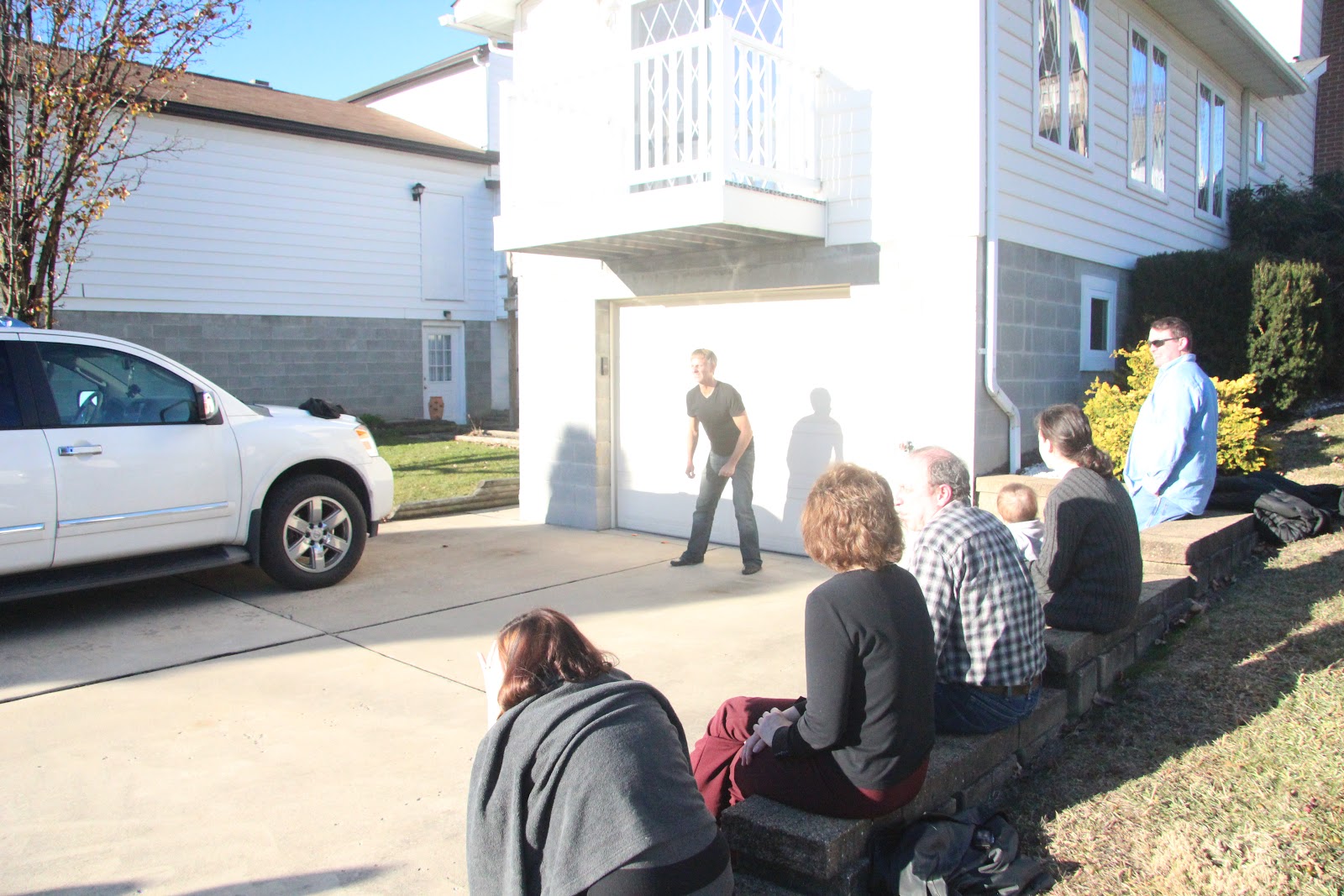
The weather was so great on Monday afternoon, December 4, that we all had a picnic lunch on the driveway with, you guessed it, more visitors. This picnic was facilitated by the fact that the freezer blew its fuse over the weekend (we just discovered it Monday morning), and much meat was in danger of spoiling. Averse to the thought of spoiling meat, and being voracious carnivores, we had us a good old-fashioned Pennsylvania meatfest. Here is a ground-level shot of the meatfest:


Here is an aerial view:


We decided to go to the park later. The boys in the back seat are getting a little raucous:

Zender, Nathan Pilkington, Jason Pilkington, Clyde Lynn Pilkington
(In the back seat, Jason's son Percival.)

"Dad, are we there yet??"
Fun on the swings with Clyde and Martin.


Clyde Lynn photographed me on Tuesday doing my Internet show:


We have hired a really nice girl to start cataloging thousands upon thousands of books for the online bookstore. These books have been waiting a long time to be catalogued, because we keep picking up thousands of free books from libraries in Pennsylvania, namely the Altoona library, and, more recently, the library at Tyrone. (You have not lived until you have driven to the Tyrone library in a Ryder truck with Clyde Pilkington. I wish I’d taken photos of that adventure; next time, I will.) Anyway, here is Heather. She is sitting at my desk in this photo, but will soon have her own little office next to Nathan’s shipping department:

Heather commandeering my desk.
(Clyde's desk directly behind; Clyde Lynn's office in back room.)
Someday soon, I will give you a video tour of our work area. I promise.

Ozzie and his wife Becka (Aaron Locker’s sister) visited last night, with their son Aydin:


Jason and Nathan had a good time, too.


Aaron loves his nephew.


Clyde Lynn and I rounded out last evening with night shots of 410 Bedford Street. This is where we all work. (I live in the house to the right, at 412; sorry, no Christmas lights, and no photo for now.)


Tomorrow (Friday) I drive to Fairfax, Virginia, for fellowship with a long-time supporter, Doug Witherspoon. He has invited me to fellowship with his family, and to share the great truths of God. I have never met him, but am looking forward to spending three days with Doug and his family. I will report from there this weekend, complete with photos. Can't wait!

Until then, grace and peace.

Martin


© 2012 by Martin Zender

Sunday, December 02, 2012

WHY AREN’T WE HAPPY?


Someone wrote me this morning to tell me she was happy. I was happy for her. Her happiness, she said, came from God. This, too, made me happy. I told her that while I was satisfied in Christ, I wasn’t sure I could drum up the word “happiness” to describe my feelings throughout the day. I do have moments of happiness (when I’m writing, or recording audio messages, or eating raisins and salted nuts, or hearing about someone else’s happiness), but I can’t honestly call “happiness” my default setting.

I used to be able to call it that back before October 1, 1993, when I began studying and teaching about God full-time. You’d think this would have led to complete happiness. Yeah, me too. I see we are both rather naive that way. I am less naive now, and also less happy.

This is not to say my satisfaction and joy in Christ and in God haven’t inched me, since 1979, incrementally and continually toward heaven. I am so anticipating my place among the celestials that I’m starting to smell the coffee and taste the wine. I’m bracing myself for the sweet riddance of gravity, which has irritated me ever since watching the first American spacewalk in 1965. 

This ain't the third heaven.
Tell me something about happiness. Is it that we are looking for something we don’t have? I’m seriously asking. Or is it just a deep-seated dissatisfaction with the nature of this eon, and of knowing the joy that awaits us in heaven with God, Christ, and all the saints? I feel sorry for Paul, who got a glimpse into the third heaven, then got shoved unceremoniously back into some crappy, third-world city. Maybe life was better for him after that, but I doubt it. Is it better to have seen the third heaven and returned, than never to have seen it at all? I think witnessing such wonders can only make it harder to floss one’s teeth and change one’s socks. For most of us, humiliation is all we know; ignorance can be bliss.

I have a theory that Paul saw the body of Christ completed; he saw us all glorified; he actually saw it, much as John saw real things yet future. I misspoke there. John didn’t see the future, he went there. Paul saw something real yet foreign to his earth-bound time and mind. I believe the vision came and went in a blink or two—seconds, probably less. Still mortal, how could Paul have borne more? He returned to his third-world mayhem convinced he was God.

Where do I get that? Seeing himself glorified so glorified him that his non-Christ, still-mortal mind mishandled it, as only mortal minds can. Clunking back to earth, Paul wrote: “Wherefore, lest I should be lifted up by the transcendence of the revelations, there was given to me a splinter in the flesh, a messenger of Satan, that he may be buffeting me, lest I may be lifted up” (2 Corinthians 2:7). The only other time Paul uses the Greek word translated “lifted up” (hupairo), is 2 Thessalonians 2:4, when the man of lawlessness is “opposing and lifting himself up (hupairo) over everyone termed a god or an object of veneration, so that he is seated in the temple of God, demonstrating that he himself is God.” 

My big beef with God is that He doesn’t have skin on. My big beef with Jesus is that He hasn’t been here in 2,000 years. I am tactile. I think my happiness has to do with fellowship, touching skin, and getting into another person’s mind. It has to do with hugs, Bibles, handshakes, eye contact; I would love to kiss someone on the lips and smell her neck. I had that with Rebecca, but that rug got pulled out and I couldn’t relocate the rug because it grew legs and ran to a foreign country. So things are lonely—in that way. (I won’t be buying a dog or cat for it. No. There is the eye contact, yes, and some of the neck stuff, but not the getting into the mind.) I’ve been told that lonely is dangerous. Why? “People make bad decisions from that place,” it has been said. I think the people telling me this may be overcautious. I’ve never been that way, but I’m giving these people the benefit of the doubt and withholding it (the benefit of the doubt) from myself.

My standard answer to people who question my one dissatisfaction with the Deity is: “God gave us other people containing His same spirit, and I praise Him continually that He gave these people epidermises.” We humans are meant to touch and have this reciprocated. If this need is not satisfactorily and legitimately met, the soul, reaching for it, comes up with air. This so agitates the soul that it informs other regions of the mishap, and soon the disposition—in spite of Christ—becomes something we may vaguely call “unhappiness.”   

I’m not ruling out a lack of minerals.  

As we grow older, we accumulate more and more losses. We lose our parents, our lovers, our extended families, our siblings—some of us even lose our children. Life can never be the same after such calamities. The body forms a scar, but the brain merely forms pockets, pooling the pain. The bad thing about pockets is, you can always reach in and pull stuff out. As losses mount, so do bad memories. These memories, in turn, mount you onto a wall-mount of cynicism until you feel and may even look like a deer (head only) whose last memory was an oncoming car. This, in turn, can possibly make you even more unhappy. (I'm not ruling out a change of fortune.) Such unhappiness can occur—miraculously—in spite of a growing realization of God. 

I think a lot of people are suffering calamitously. Let me know if you are; I want to know. My latest loss has driven me harder and deeper into this miraculous organism known as the body of Christ, and I think the water is fine.  

Tuesday, November 27, 2012

STAY THE COURSE


My sun sign is Libra: the scales. Before I make a decision, I balance everything out. I weigh, sniff, taste every alternative. It is said that people waiting for a Libra to make a decision will time the process with a calendar rather than a stop watch. I’m not that bad. At least, I don’t think I am. Wait a minute. Maybe I am. But then, I might not be. Hmm. Can I get back with you?

But when the Libra finally does make the decision, you might as well sit down and make yourself comfortable. I can, at all times, be persuaded by opposing facts, but until that happens, I have driven my tent stakes ten feet into the ground (they are very long, heavy tent stakes) and it takes an act of God to blow away my conviction.

This is where we all need to be in the closing days of this eon: decisive and then sure. We must weigh the facts of every matter (family matters, spiritual matters, matters concerning our bodies and health) and make decisions. When we’ve made them, we must trust the reasons we made them, and stick with those reasons until other facts redirect us. Because, folks, the winds are going to blow.

When you run a marathon—a 26.2 mile race—you always wonder—usually somewhere after the 20-mile mark—why the hell you decided to run a marathon. It seemed like such a good idea a couple months before, while dreaming of the glory of crossing the finish line during an easy training run.

Then comes the race. It’s fun at first (I have run five marathons). The excitement of running with great gobs of people and drinking as many free cups of Gatorade as you can choke down, makes you glad you entered. But then comes the 20-mile mark. As the waffles at the bottoms of your shoes melt into the pavement, you question your sanity. And how can there be so many other stupid idiots in one place, doing the same stupid thing?

While suffering, it is easy to talk yourself off the course. When your legs start cramping and you can’t slake your thirst anymore, you must trust that you had good reasons for being here. You can’t think of one of them now—it’s true—but you know you had at least a couple. Thus, the marathon now becomes a run of faith. You already made the decision—now keep going. Try to remember the days when you had weighed this out, and decided to do it.

None of us decided to be born. But we did decide to get married. To have kids. To take that job. To buy the car. To start the exercise program. To follow Christ no matter what. I have heard so many of you say, “I can’t turn back now. How can I go back?” I hate to say this but, relatively speaking, you can go back. You can quit the fight. I know that’s a scary thought, but it’s real. This happened with some of Paul’s closest companions.

“Demas, loving this current eon, forsook me” (2 Timothy 4:9).

Incredibly, it happened with all the ecclesias of Asia:

“All those in the province of Asia were turned from me” (2 Timothy 1:15). They were turned, not just from Paul, but from his message.

We cannot lose membership in the body of Christ. But we can—by walking off the course—lose rewards at the dais of Christ given to those who endure (2 Timothy 2:12).

This is a marathon, folks, and it ain’t over ‘til it’s over.

It ain’t over.

© 2012 by Martin Zender

Saturday, November 24, 2012

LIVING AT THE SAME ADDRESS: CHRIST


Moving is hard. When I was a kid, we never moved. Well, I did move when I was 2 years old, but I don’t remember it. I must have been sleeping. My parents may have bundled me up in a bundler of some kind and put earmuffs on my ears and eyes (“eyemuffs”) and kidnapped me to a new address so that the “big move” to a bigger house two miles away would not unduly upset my precious world. And it was a precious world. My parents made it that. They wanted me to have a precious world, and I did.

Hanging out on Ivanhoe
We moved from a street called Ivanhoe in Canton, Ohio, to 4924 18th Street, where I lived until I was twenty. Not many people enjoy this kind of stability anymore, what with the transient and violent nature of this planet and the eons cradling it. Have you noticed the instability of this world? The earthquakes? The hurricanes? The floods? The mudslides? The local newscasts? Just when you think you can count on things staying the same, the earth quakes, the mud slides, or the news casts, and you find yourself wishing for the good old days of five minutes ago.

The apostle Paul wants us to be rooted and grounded in the truth: Ephesians 3:17-19:

Be made staunch with power, through His spirit, in the human within, Christ to dwell in your hearts through faith, that you, having been rooted and grounded in love, should be strong to grasp, together with all the saints, what is the breadth and length and depth and height, to know the love of Christ.

The only way we can know the love of Christ is to be rooted and grounded in the truth that Christ loves us. If you flinch or flicker in this knowledge, you will often wonder whether the love of Christ really exists, or if it’s just a passing fancy of His.

Stability in life helps this. They say your first image of God is what you see in your earthly father. Likewise, our first image of being rooted and grounded in the love of Christ is the kind of rooting and grounding we experience early in life. I speak of being settled during our formative years. I speak of having time to develop relationships, of playing with the same kids, and having the same neighbors stopping by for a drink on Christmas. This is not necessary to a spirit-filled life, but is a gift of God helping set the foundation for one. If you can provide this kind of stability for your kids, then try like hell to do it.

But I still like you, Pikes Peak.
For all my bubbly, stir-the-pot nature, I love stability. This move from Colorado has been hard. Moving to Colorado was hard, because I had lived in Ohio for 52 years. For a year, I struggled to adapt to my Colorado home. Just when I got settled into the mountains and the sunshine and my precious wife, my wife excised me from her life, and the mountains didn’t seem to care about me any more. This still shocks my system; my system is used to stability. Would I stay in Colorado? I thought I would. But the memories—which were everywhere—killed me softly. Some people say I’m too emotional—stop it, you’ll make me cry. Change is foreign to my nature and my upbringing, so it hits me like an 8.9 quake.   

I am now living in Pennsylvania, where love and peace rise like morning mist from the oldest mountains here. (The mountains here got formed and covered thousands of years before those of the Rockies.) I want to travel. I am endeavoring to plug into the truth that God is everywhere, and that I take the spirit of Christ with me wherever I go. I have always known this, but now it enters the liver through the heart. If the spirit of God makes its home in me (1 Corinthians 3:16), then I am at home wherever I am. This high truth defies zip codes.

I am looking forward to the stability of my celestial home from which neither I—nor any of us—shall ever be excised.  

© 2012 by Martin Zender


Wednesday, October 24, 2012

THE SELF-OBSESSED


Someone recently asked, “Are you sure your ministry and your writing isn’t becoming more about you, and less about God?”

I could barely understand the question; no one plunged headlong into this work ever thinks this way. To think this way requires 1) an unhealthy examination of self, and 2) an unhealthy spiritual dichotomy that must doubt, moment-by-moment, the indwelling spirit.

Paul writes in 1 Corinthians 4:1-5:


Thus let a man be reckoning with us as deputies of Christ, and administrators of God's secrets. Furthermore, it is being sought in administrators that any such be found faithful. Now to me it is the least trifle that I may be being examined by you or by man's day. But neither am I examining myself. For of nothing am I conscious as to myself, but not by this am I justified. Now He Who is examining me is the Lord.


I, too, am an administrator of God’s secrets. As such, I am expected to be found faithful in all aspects of life, personal and spiritual. Rightly so. Of nothing am I conscious as to myself. In other words, I believe myself to be a good representative of Christ. Does this justify me, in the personal sense? No. How can anyone know the depths of his or her own soul? If these inner caverns are hidden from each of our eyes, what is to be done?

Self examining self

The temptation, for an administrator of God’s secrets, is to examine himself; to continually question his motives: Am I doing this for God, or am I doing it for myself? This is a useless, hazardous enterprise, as it takes energy from the work at hand and directs it self-ward. Self-examination—as far as proclaiming the evangel goes—is a trap of the Adversary.

Paul wrote to the Philippians:

Some, indeed, are even heralding Christ because of envy and strife, yet some because of delight, also; these, indeed, of love, having perceived that I am located for the defense of the evangel, yet those are announcing Christ out of faction, not purely, surmising to rouse affliction in my bonds. What, then? Moreover, seeing that, by every method, whether in pretense or in truth, Christ is being announced, I am rejoicing in this also, and will be rejoicing nevertheless.


Some of the brethren, grieving for the jailed apostle, heralded Christ out of delight for the message, probably hoping to delight Paul at the same time. Others, jealous of Paul’s position in the ecclesia, worked hard to gain converts, hoping to “gain ground” on Paul during his Roman layover. Some say the factious announcers brought a tainted message. This is impossible; Paul would never have countenanced that, let alone rejoiced in it. No, the message was pure, it was the motive that was tainted. As to that, Paul didn’t care. As long as the message was pure, a potted plant could announce Christ.

Paul was much more than a potted plant. Was he perfect? Of course not. He refused to let his imperfection, however, derail the task for which he was born and called. Here is a devious trap of Satan: Are you sure you are doing this for all the right reasons? Maybe you ought to stop and examine yourself. Paul said, “Forget it.” To him, it was the “least trifle” to be examined by his fellow saints. For surely, there were those who would make a career of examining Paul, and others like him. If Paul paid constant attention to, or responded continually to, these critics, he would never have written or spoken another word.   

Theodore Roosevelt describes the “armchair quarterback” syndrome:


It is not the critic who counts; not the man who points out how the strong man stumbles, or where the doer of deeds could have done them better. The credit belongs to the man who is actually in the arena, whose face is marred by dust and sweat and blood, who strives valiantly; who errs and comes short again and again; because there is not effort without error and shortcomings; but who does actually strive to do the deed; who knows the great enthusiasm, the great devotion, who spends himself in a worthy cause, who at the best knows in the end the triumph of high achievement and who at the worst, if he fails, at least he fails while daring greatly. So that his place shall never be with those cold and timid souls who know neither victory nor defeat.


It is easy for spectators eating popcorn in the bleachers to tell soldiers how to fight. Funny that none of the critics ever wants to take the place of the soldier. 

Paul refused to let others examine him, for neither did he examine himself. In the first place, human examination along this line is impurely sourced; it comes from “man’s day.” The only one capable of discerning true motive is the Lord, and Paul contented himself to wait upon Him. In the meantime, he brushed aside the “man’s day” brigade. (I’m still working on that part.)

Barnum and Bailey

A petty criticism leveled against this work (by only a few over the years) is that the worker is a showman, a performer. I am what I am, and what I always have been. I missed the cookie-cutter-man-of-God assembly line, sorry; I was out picking daisies, rolling down hills, and constantly entertaining my classmates at school. One of my uncles is a Hollywood playwright, another joined the circus when he was fourteen and eventually married the Sheep-Haired Woman from the sideshow.

Any further questions?

What is the problem?

As I’ve always said, there are those who are pious and humble on the outside, but who inside are full of pride. Then there are others, like me, who may be a bit blustery and showy on the outside, but who inside know that they know that they know their sufficiency and ability come from Christ.   

The new "I"

Galatians 2:20—

With Christ have I been crucified, yet I am
living; not longer I, but living in me is Christ.

This speaks to the second point mentioned at the start of this blog: It takes an unhealthy spiritual dichotomy to continually examine one’s motives in proclaiming the evangel.

I was crucified with Christ 2,000 years ago. But wait: I am still living. But wait again: the “I” that was living before being crucified with Christ, is different than the “I” living after, because now, “living in me is Christ.” In other words, “the spirit of God is making its home in [me]” (1 Corinthians 3:16). The pronoun is still, “I,” but the change could not be more profound. I have graduated from a self-centered “I,” to a Christ-centered, “I.”

Regressing toward the old "I"
A lot of people don’t get this; they stumble at the word “I,” whether pre or post-Calvary. This is the dichotomy I spoke of. The mature person assumes Christ within and has no problem saying, “I”; the immature person lives much of his or her life on the wrong side of the cross and is constantly suspect of “I.” These immature are the ones continually trying to sound humble; they have yet to appreciate, “I live; living in me is Christ.”

Then there are those like me who have given up the game of trying to sound humble, who appreciate the death of the old “I” at Calvary, and who therefore use the new “I” with relish. Those able to do this are, in their liberated, guilt-free use of the infamous pronoun, actually on the right side of Calvary—the post "death-to-self" side.

(An obsession with "I" is the resurrection of self; a denial of the truth of Romans, chapter 6.) 

Because I rarely consider myself on the pre-death side of Calvary where “self” is constantly alive, kicking, and troublesome, I generally assume other people to be where I am. I give others the benefit of the doubt, later to find—when they attack me for self-obsession—that the benefit is undeserved. It is those on the wrong side of Calvary—who assume my abandonment of false humility to be self-obsession—who are, in fact, self-obsessed.

To the one who has died with Christ, there is only one “I.” To constantly jump that chasm back and forth between pre and post Calvary, is not only exhausting, but unnecessary. It is also unspiritual.

Who wrote my books?

I asked one of my detractors recently: “Since you think there is too much of me in my work and not enough of God, maybe I should just put “God” as the author of all my books.” (You can see the “lose-lose” proposition here.) If my books are by “Martin Zender,” I’m promoting myself. But if I take the absolute tack and make “God” the author of my books (this is supposed to be the humble approach?), then how dare I claim to be the Deity?

Lose-lose.

I laid a little trap for one brother recently, telling him, “I have brought many people to Christ, through my books.” He took the bait, and said, “You have brought many people to Christ?” (He sounded incredulous and shocked to hear me “taking the credit.” ) “Yes,” I repeated, “I have brought many people to Christ.” He could not believe I could be so arrogant as to emphasize the pronoun, “I.” Surely, this proved that my ministry was “all about me.”

After letting this go on a while, I quoted Paul in 1 Corinthians 9:22

“To all have I become all, that I should undoubtedly be saving some.”

“ ... that I should undoubtedly be saving some,” said Paul.

(But Paul, I thought Christ saved people—or does God do it? In any case, how can you say that you save people? Do you think that maybe your ministry is becoming more about you, and less about God?

This is a clear case of the absolute vs. the relative perspective—and of misunderstanding it. “Be carrying your own salvation into effect, for it is God operating in you, both to will and to work for the sake of His delight” (Philippians 2:12-13). Here is the absolute and relative perspective within two verses. God does things through us. The “I” (or the “us,” in this case) is relative, not absolute.

There is not a religious qualm in the world—voiced by another—that could make me abandon my healthy use of the pronoun “I.” There is not a religious qualm in the world—voiced by another—that could keep me from putting my name on the books I write. (“How dare you say you wrote these books!”) Rather, I have put aside these religious over-sensibilities and have embraced the post-Calvary “I”: God does this mighty work through me; through me.

God employs cracked pots

Jesus had a Messiah complex. 
This does not mean any of us are perfect. (I have been told that I think I am “nearly infallible” and that I have a “Messiah complex.” Really? I should be having a much better time of things in this life, then. I thought I was a mistake-riddled human being struggling through an evil eon; I could actually use a Messiah complex about now.) It does not mean we do not make mistakes. What it does mean is that we refrain from analyzing our motives for heralding the Word. It means we refrain from answering every critic along that line. When it comes to heralding this evangel, self-analysis is a useless, unspiritual enterprise.

In my last blog, I explained how the term “sex-obsessed” described, not those for whom the marvels of sex are a regular part of their conversations, but rather those chronically offended by sexually-oriented things. It’s the same thing with self-obsession. “Self-obsessed” describes, not the Scripture-worker doing his job, unconscious of any blatant wrong-doing, but rather the person who is constantly worried whether or not an act (his, hers, or someone else’s) is “of the self.” This is the self-obsessed person.

It’s all I’ve got

“Herald the Word, opportunely and inopportunely” (2 Timothy 4:2).  

For me—still in the midst of trial, enduring fightings within and without—this seems like one of the most inopportune times ever to herald the Word. So what do I do? The only thing I know how to do:

Herald the Word.

© 2012 by Martin Zender

Wednesday, October 17, 2012

THE SEX-OBSESSED


It has been recently suggested that my books are “full of sex.” When pressed for an example, the only one offered was the opening story in Flawed by Design, where the prostitute, about to pour her tears upon her Savior’s feet in anguish over her occupation, wrestles in a field before dawn with God—with what He made her. She shakes her breasts in front of Him, daring Him to kill her. Falling to the earth with bitter weeping, she expects a lightning bolt. Instead, she feels His tender compassion.

Many people have written to tell me how this passage moved them to tears—in fact, all the writers have been women. (After ten years, I am still moved to tears whenever re-reading this story.) In my opinion—and in the opinion of many others—this story perfectly introduces a book about being flawed by design.

But what kills it, in the mind of some, is the word “breasts.” Worse, I briefly describe the prostitute’s breasts as being perfect. “I can’t hand out this book to people,” says a friend, “for fear they would stumble at it.”

Oops.
I wonder if this friend, who finds the brief allusions to sex in some of my books so objectionable, has trouble handing out the Bible. He should. If the standard for an “unsharable book” is the mention of sex, the Bible wins hands down. The Bible is full of prostitutes, concubines, penises, breasts, polygamy, seed-spilling, and menstrual cycles. The entire book of Song of Solomon fits the modern-day standards for erotica. In Esther 2:5-7, it is God Himself Who points out, concerning Esther: “The maiden had a lovely shape and was good-looking in appearance.”

By my count, God brings up sex about 1,000 more times than I do. I have a long way to go to catch up with Him. I probably never will; He created sex, and I did not. No wonder He’s so unapologetic about it.


HUMANITY ON DISPLAY, I.E., “HONESTY

What makes my work so different and effective is that I am myself. In the midst of giving you spiritual truth, I tell you about my life. I am not ashamed to be human in every category of life, not just the sexual category. This honesty helps people like my books. I don’t have to work at it, because being myself is the most natural thing in the world to me.  

The only thing worse than an M&M is a sexy female one.
If you were to listen to the old ZenderTalks and read my early books, you would notice two common themes: M&Ms and black coffee. Back in the day, I was passionate about these things and often shared with readers and listeners how these two products helped me through life. It is interesting that no one has ever accused me of being “coffee obsessed,” or “M&M obsessed.” It is only when I mention the word “breast,” or bring up some aspect of feminine beauty, that some people become offended. The conclusion is unavoidable: Those who object to the sexual references but not to these other things believe M&Ms to be good, but sex to be evil. Coffee is pure, but sex is tainted.

This is Gnosticism. (Google it, folks; it ain't pretty.)

As Kingsley G. Bond writes in the foreword to Clyde Pilkington’s book, Due Benevolence: 

It is not surprising that the mistakes of our [religious] past should have given us
a poor view of something that God made and pronounced "good." It is almost
impossible, now, to divest ourselves of the view that sex is an obscenity. However strenuously we try to disturb our prejudice against it, the view is deeply ingrained that sex is a power which exercises a hold over life that is at least dangerous and more likely evil. Containment is the common approach, instead of liberation.

Sex is not a monstrous mistake of the Creator, but something for which we may
expect that God holds a constructive purpose in view. No doubt that purpose is
being served in spite of our upset situation, but how much better if the good for
which this faculty was intended could be pinpointed and its drive directed into
ways that would benefit all.

Sex is in just about everything. This is not bad, but the natural way of things.
Therefore the Christian has to start where the Bible starts, by acknowledging
things as God has given them to us. After all, the whole of life is either male or
female, and of all the instinctive drives that have been given to us, hunger is the
most compelling, but sex is the most pervasive. It naturally touches everything …
Indeed life would be cold, hard, and metallic without it. God did not give us a
sexless world. It is not for us to fight against God’s order of creation, but rather to
seek to know more and find the line of purpose to follow.

Kingsley G. Bond,  
Tidings (1967)

 Clyde Pilkington writes in the same book:

We have a Bible filled with sex. There was clearly a different mindset in Biblical times. There is a different mindset by God. What seems so unusual to us was commonplace within their setting. Our religious society has mastered the art of calling “evil good, and good evil” (Isaiah 5:20). In one sweeping motion, they have taken God’s wonderful gift of sexuality and almost uniformly called it evil.

                                                SEXUAL OBSESSION

This poor guy is sex-obsessed
What is sexual obsession? Remember how I pointed out to you in my book, How to Be Free From Sin While Smoking a Cigarette, that a slave of sin is just as much someone who sins like crazy as someone who tries like crazy not to sin? Slavery to sin requires a fixation on sin—whether to resist or indulge it. The same paradox applies to sex. I make a brief mention of sex in a book or a talk, and the religious reader (the reader for whom sex—in spite of his or her protestations to the contrary—is inherently evil), fixates upon that passage and can’t let it go. I have long since moved on to another topic, but the sex obsessed can’t move on. Why? They are obsessed with sex. I have moved on, but they haven't.

Who is obsessed with sex?

To speak openly about sex is natural. To celebrate feminine beauty (God Himself sets the pace here; read Ruth and The Song of Solomon), is natural. God pronounced the male and the female “good.” To make it evil is yet another ugly by-product of religion that infects even the saints.

Wake up, people
When it comes to human sexuality, I often feel like the most normal, well-adjusted person in the room. I wish this liberation upon all who read. Those who will dare to begin considering sex as God considers it (He considers it “good”) will—paradoxically—find themselves at last delivered from the sexual obsession that has so oddly turned them against the natural marvel of the female breast.  

© 2012 by Martin Zender

(To order Due Benevolence, Clyde Pilkington’s “revelation-a-page” treatise about Biblical sexuality, click here: /http://duebenevolence.com/. It is the best 25 bucks you will ever spend.)


Friday, October 12, 2012

SUFFERING

Trial brings some things besides pain. But mostly, it brings pain. The value of the cross centers upon the suffering of Christ. When we think of the suffering of Christ, we think chiefly of the cross. But I think His worst suffering was Gethsemane. That's when Satan tempted Him to walk away, but when He knew He must walk through.

If God had given Christ an alternative to the cross, He would have taken it. Immediately. Gladly. The value of overcoming trial is proportionate to the realness of the trial. Theoretical trials don't work. If our Lord and Savior does not desperately wish to escape, His staying does not stun us. His obedience is what stuns us. It's the staying. 


Have any of you ever been so beset by a trial that you think it is beyond your endurance to bear it? I'm sure you have. You want it to end, and would even leave the world, if God would grant it. It is that real. Nothing theoretical. But you stay. Staying leaves its mark—on earth, and in heaven. It leaves its mark, too, on the sufferer. Some marks are metaphoric, some literal.  

I am undergoing a trial now that is so severe I cannot start the Revelation show, as I promised. I don't have the emotional capital to be alone in a room talking to a camera and a microphone, even about the great things of God. I don't know when I will again. The great things of God seem less than great to me right now. My view is temporarily dimmed. All I have right now is faith.

Clyde Pilkington would have been a good general in an army. He is a general in the army of Christ. Very few teach the true gospel of Paul full-time in the earth today. Among those who do, Clyde Pilkington is their general. He does not think of himself as such; he is a working general. He is the general in the trench with his troops. He cannot help being what he is; God made him a gifted encourager. 

Dan Sheridan called this morning. No one reading this realizes what Dan Sheridan has undergone these past two years. I did not even realize. Satan has a target on Dan's back; do not judge until you know. Dan went from teaching the gospel of grace full time, to his own Gethsemane, where he has been for two years.

There occurred, this morning, a miraculous three-way conference call between Dan, Clyde and me. It was miraculous because of the respective trials and that the general was on the line. It was miraculous because of what God brings out of trial, when one least expects it—and doesn't even think one wants it.  

The short of this is that Dan and I are reviving the Zender/Sheridan show—tonight. We will record the first show tonight, over the phone, and plan on releasing it Monday, God willing. I have no other details right now.

All of this took place twenty minutes ago. It was born out of trial and pain and the necessity of staying in this trench, staying in this war when Satan would have us out. I cannot now speak alone in an empty room—even about God—but I can speak to my brother about God. And I will. We don't know exactly what we're doing, but we've done it before, so it will come to us. We will talk about the political situation on the earth today, as well as the situation, on earth, of the members of the body of Christ—in the midst of it all. How do we live as strangers in such a strange place? How do we live when our realm is inherent, not here, but among the celestials? Does it matter who is elected on November 6?

Thank you for your prayers, for both Dan and me. Please pray for Clyde as well. Pray for everyone attempting this kind of work. 

Sorry for being away from this blog. Thank you for your patience. Thank you for not forsaking me. 

We will talk as the days progress. 

Watch for an email about the all-new Zender-Sheridan show. 

Watch for the snatching away, when you shall be picked up by strong arms: Christ's.

© 2012 by Martin Zender