Sunday, September 30, 2012

SENECA FALLS, NY, CONFERENCE SITE

Greetings, everyone. This has been one of the most unique conferences ever. There is no way I could possibly tell you everything, here, now. I'm sitting at the kitchen table in the middle of the gorgeous a.m. cacophony of nine people readying themselves for the last sessions this morning. There is a light rain now on the lake, but even that can't help being beautiful.

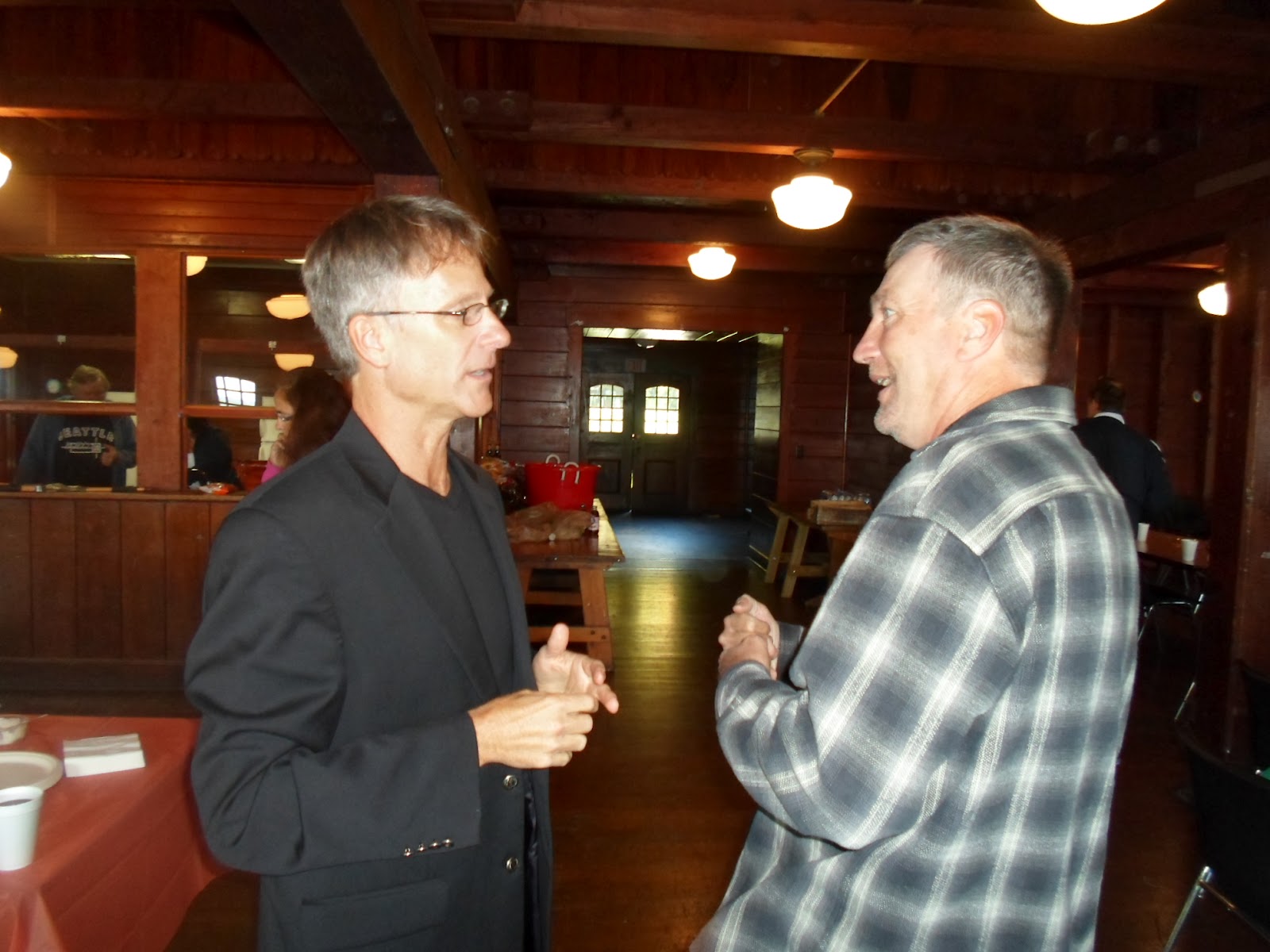
Many of those in attendance this weekend, I have never met. Many things have happened at this conference, that have never occurred at any other. If I start writing now, I'll fail to properly capture the times and moods. For now, I will share some photos. This evening, look for a video that will communicate the feel better than 1,000 words. I'm running out of time this morning, so I will label these photos later. Please stop back.

Thanks!

Grace and peace,

Martin

(Click on photos to enlarge.)
Clyde Pilkington III, Harsh, Aaron Locker, Andre Sneidar, Nathan Pilkington.

Conference site

Nathan Pilkington

Steve Hill, Aaron Locker, Nathan Pilkington

Cayuga Lake, one of the five "finger lakes" of upstate New York.


Jon Krause

My sister Kelly and Clyde Pilkington


Len Paganelli, Kelly, Lenny Pappano

James Huff, Wallace Barnett


Clyde Pilkington III, Clyde, James Huff, Wallace Barnett
Aaron Locker


From the back porch of our house


Steve Hill

Dan Sheridan

Jon Krause


Steve Hill, and Kelly

Saturday, September 29, 2012

GRIM LESSONS IN ABOUNDING


Paul writes in Philippians 4:12:

"I learned to be content in that in which I am. I am aware what it is to be humbled as well as aware what it is to be superabounding. In everything and among all am I initiated, to be satisfied as well as to be hungering, to be super-abounding as well as to be in want. For all am I strong in Him Who is invigorating me, Christ!"

We are trying hard here in New York to be humbled, hungering and in want (suffering for the evangel carries such rich future blessing), but it's not working too well. Future blessing is temporarily deferred, I guess, as we luxuriate in our God-appointed digs. Lenny Pappano rented a home for the speakers and their entourage at a lakeside vacation home, so here we are this morning, fellowshipping before a full day of fellowship.

Unfortunately, my wife Rebecca could not make this trip, and she is missed by everyone.

We miss you, Rebecca!

I needed last night at the conference site; it is so great to see the saints. Dan, Clyde and I each gave introductory remarks, but for 90 minutes afterward, all present contributed. The site is rustic and so first-century. The "round-table" discussion went on later and later; no one cared for the time. Several people remarked how badly they needed this this time together. I will take photos of the site and post them tomorrow morning, God willing. In the meantime, here is a photographic log of "the suffering nine."

My sister Kelly.
(Click on photos to enlarge.)
Clyde Pilkington III.
Making the best of things.

Suffering evil for the evangel is such a drag.

Dan Sheridan is in fine fettle this morning.
Wish Lenny had gotten us a better view of Lake Cayuga.
Kelly and Clyde III. And is that Moses?
Not exactly a day and night in the swamp.
Andre Sneidar, Clyde Jr.'s editor, publisher, and friend.
It rained all day yesterday, but today we see the sun.
Clyde Pilkington. 
Aaron Locker spruces up for the day.
Nathan Pilkington with his lover.
Early-morning sun.
Kelly and Clyde's wife, Janet.
What a privilege to work with my brother Clyde.


Thursday, September 27, 2012

THE FIRST GENERATION TO BE RIGHT


Though I champion and live by the letters of the apostle Paul, there is one other Bible book that interests me nearly as much, and that is the book of Revelation.

It was not always this way. Anyone first reading the last book of the canon (God help the individual attempting it in one sitting), usually reaches for an adult beverage afterward. It was the same with me (except I ate peanut M&Ms). All that changed, however, when I read The Unveiling of Jesus Christ, by A.E. Knoch.

In 1930, A. E. Knoch wrote the definitive work on the book of Revelation. I believe Knoch to be the first writer holding mature truth to tackle this difficult book. What do I consider mature truth? That would be a knowledge of, 1) the eons, 2) the sovereignty of God, 3) the goal of the universe, and 4) the distinct evangel of Paul.

Most Revelation commentators founder on all four counts. Being ignorant of the eons, they imagine the judgments described here to be everlasting. Unaware of God’s sovereignty, they miss divine purpose. Because they imagine the goal of the universe to be eternal torment (how delightful), they must make the lake of fire “all she wrote” for the majority of humanity (how fun). And no one getting Revelation explained by an author ignorant of Paul ever finds comfort—or enough alcohol. Escape out of the coming indignation? Not quite. (Paul begs to differ: 1 Thessalonians 1:10). Rather, take a dose of a certain fearful looking for ill-tempered locusts and ninety-pound hailstones.  

The ultra-intelligent A.E. Knoch is still childlike enough to believe God means what He says. Allowing for figures of speech (the author’s grasp of these is exceptional), A.E. Knoch audaciously takes God at His Word. Is taking God at his word a scary proposition in the book of Revelation? You bet! But only if you, too, miss the four planks of full-grown truth.

Why don’t many people know about The Unveiling of Jesus Christ? That’s what I’d like to know. There are more revelations in one paragraph of Knoch than in entire volumes of seminary-trained drones. Rather than griping about it, I’m going to do something about it.

God willing, I will launch a video series on the book of Revelation, next month. I will base the series—set to broadcast five days a week—upon Mr. Knoch’s seminal work. No sense re-inventing the wheel; A.E.K. has already written a masterpiece. My contribution will be to “Zenderize” his words and concepts, making them digestible even by seminary-trained drones. Heck, I may even make some of his concepts funny.

Please pray for me, as I cannot do this work alone. It’s too damn hard; I’m not smart enough; I’m not disciplined enough; I’m not good enough; I become too easily discouraged by the uphill task and the downhill world. I could give you 122,465 more reasons why I need help and prayer, but these will suffice. Are you praying yet? Why not? Please pray now.

Really. Exactly. Truly.

Here is a promotional video, fresh out of the production department:


Friends, we are the first and only generation since John scribbled his head off on Patmos to witness the beginning of events God showed him, “in spirit.” These are the end times. Yes, I know every generation has said that.

But we are the first generation to be right.

© 2012 by Martin Zender

ANTI-TEACHING


Sometimes, the best way to teach what is right is to put what is wrong on full display. I will do this in October, after returning from New York.

Many people believe that God is a well-intended old man who had such high hopes for his creation—up until Satan ruined his plans in the Garden of Eden. (I call this eternally disappointed personage, “the Christian God.”) Since then, the Christian God has scrambled night and day to salvage something, anything, of his universe. He sent his own son, Jesus Christ, to save as many as he could from a fate worse than death: burning in hell forever. 

Burning in hell forever is the worst thing imaginable. In fact, it is so bad, so evil, and so nightmarish (and so freakishly hot), that no one can possibly imagine it. Not even the Christian God can truly wrap his poor demented mind around it. He is sorry about it, really. But this is just what happens to people who don’t love him. All people have to do is love him. Is that so hard? The Christian God spends many long hours stroking his long, white beard in quiet contemplation, wondering why so many people can’t manage so simple a thing as loving him. Isn’t he the most loveable being in the universe? Of course. So why doesn’t his favorite saying, “Love me, or else!” attract more devotees?

The problem, of course (well, one of the problems), is that the Christian God gave every human being a free will. So while he may wish to influence these humans and bring as many as possible into his heavenly, air-conditioned home, he can’t. Once he gave away his sovereignty, he couldn’t get it back. Now, the best he can do is hope everything somehow works out. (He knows in his own heart—the one with the aorta and all the ventricles—that this is probably not going to happen. But it doesn’t mean he can’t wish for it.)

I have already shown you the Christian God in several of my Crack O’ Dawn Report videos. In case you have forgotten, here he comes now:


Some people get nervous about me portraying God. They think it’s sacrilege. But I’m not portraying God, I’m portraying a caricature of God—the weak, bumbling, co-dependent “deity” of the Christian religion. I can teach the truth about the true God straightforwardly, and often do. But sometimes the better thing is to let the error act and speak—give it its say—and let people see and hear for themselves how wrong it is. (This is the “show rather than tell” principle.)

I can stand under a tree, in a video, and—with accompanying violin music—talk about how great and wonderful the true God is. (Can you hear clicking sounds? That’s the sound of thousands of twenty year-old YouTube watchers rolling their eyes and moving to another channel.) Or, I can arrange for the Christian God to have his own comedy show, and put him on a stage before a live audience, to explain his sorry self.

I asked the Christian God about this possibility, and he jumped all over it. In fact, he was so excited he smoked seven filtered cigarettes. (Seven is the number of perfection.)

I have booked him into the famous Laura Ingalls Wilder Comedy Club in De Smet, South Dakota, for a series of engagements. The thing about this is, the Christian God is not intending to do a comedy set. He thinks he’s finally getting the opportunity to explain himself on YouTube in front of a friendly audience. See, I kind of didn’t tell him it was a comedy club. I kind of told him he’d be “giving a talk” at De Smet Community College. You may think it is mean to deceive the Christian God in this manner, and maybe it is. I am doing this for the greater good. When people start rolling in hysterics at the Christian God’s most earnest elucidations of how the universe got so whacked (“Shut up! What's so funny? You try creating tall grass, and then see if you can keep track of all the snakes!”), maybe he will get a clue.  

Here he is, last week, testing the sound system:


THE POP-ICON JESUS

The Pop-Icon Jesus is also booked into the Laura Ingalls Wilder Comedy Club, but on different nights. The Pop-Icon Jesus, however, knows it’s a comedy club. I told him, and he embraced my concept. He, too, wants to tell his story. He knows how funny utter futility can be, and is ready to let 'er rip. (Here he is at the dress rehearsal.)


The Pop-Icon Jesus is not the true Jesus. He is the handsome, popular Jesus whose glittering jewelry adorns the necks of rock stars and Super Bowl heroes. The events of the past two millennia have very much disturbed him. In the old days—as recently as the 1960’s—the Beatles were more popular than he. But now, he has all the frenzied teenagers eating out of his hand. It disconcerts him. He never wanted to be a cult-leader, he says. He suspects that his father—the Christian God—has something to do with the downhill roll of things since Calvary, and is quite happy to incriminate him. (“He has a bee in his bonnet, that one. Or a crawfish in his crotch—something. Everyone is afraid of him. It’s great for the money plate, but I used to fling that stuff across the sanctuary in the good old days.”)

The Pop-Icon Jesus looks back at those ancient days—at how un-popular he was then—and instinctively recognizes them as days of truth. The mainstream religion (as well as the mainstream media) snubbed him, yes, but that’s because his message was spiritual, rather than emotional. His no-frill message rarely appealed to the carnal nature. There were no titillating songs back then repeating his name 95 times so that people swayed and swooned and wanted to make love to him. There was no stained glass back then, no large cathedrals, and no marble statuary honoring his dear mother. Back then, his mother baked fig bars whenever he brought “the boys” over for a visit. She had no halo then, and the paparazzi shunned her. (I am not disparaging Mary; her fig bars were moist and delicious.)

Treading the road less traveled is so timelessly true. The real Jesus knows it, as do we who seek Him. “Wide is the way that leads to destruction,” He said in the day. In this day, the popular path finds happy receipt in every pulpit. The Pop-Icon Jesus hates that, and now he'll have his say.  

Tickets are still available for both shows. Call today. Operators will be wearing riot gear. 

© 2012 by Martin Zender

Wednesday, September 26, 2012

THE NINE

When we think of all the blessings that have come from Paul’s letters, we forget he was only one man. We tend to think God needs an army to conquer such a large thing as the world, and to overcome such a prevalent thing as the stupidity of the world. He does not. It pleases Him to do the most with the least. This way, the credit and glory go to Him, rather than to the vessels He chooses for such stupendous work. It is simply impossible for one man (Paul) to take over the world. And yet, he does.

Along with eight others. Nine people, in all, brought us our faith. Yes, Christ brought it, absolutely speaking, and God brought it even more absolutely speaking than that, but the Powers That Be handed this faith to a single man headed down that dirt road to Damascus. This man, in turn, handed it to eight others, who found in their soul a burning desire to receive it, understand it, and pass it on.

Sosthenes
Paul and Barnabas were the first believers of the new message (of the grace of God) to be called, “apostles” (Acts 14:4). In Romans 16:7, Paul refers to two believers named Andronicus and Junia, as being, “of note among the apostles.” In 1 Thessalonians 1:1, Paul associates Silvanus and Timothy with himself, saying in 2:1-1 that these men were “bold in our God to speak the evangel of God to you with much struggle.”

Paul mentions another man, Epaphroditus, in Philippians 2:25, calling him “my brother, and fellow worker, and fellow soldier.” Sosthenes (1 Corinthians 1:1) and Apollos (1 Corinthians 4:6) were with Paul when he wrote to the Corinthians in 1 Corinthians 4:9—“I suppose that God demonstrates with us, the last apostles, as death-doomed, for we became a theater to the world and to messengers and to humans.”

Andronicus
Paul
Barnabas
Andronicus
Junia
Silvanus
Timothy
Epaphroditus
Sosthenes
Apollos


Oh, what we owe this handful of faithful men who struggled in relative anonymity in a hot, cruel world, two millennia before any of us were born. They did it for God, but they did it, as well, for us. They gave themselves for the sake of people they’d never met, and for names they’d never heard. The men listed above deserve to be in the Faith Hall of Fame, and indeed, they are. Each of these will receive a wreath of glory from their Savior at the dais, rewarded for faithful service, compensated for the evils and frustrations endured here. We shall be present to see it.

I have written the names of these men on a small piece of paper that stays in my wallet. I feel close to them. I desire not only to see these men rewarded, but to stand with them. 

Timothy
In 2 Timothy 2:2, Paul writes to his child in faith: “And what things you hear from me through many witnesses, these commit to faithful men, who shall be competent to teach others also.” By the time Paul wrote this letter, he suspected the era would be much longer than he’d originally anticipated. Thus, he commissions Timothy to commission other men after him—men who would be competent to commission yet others.  

It has come down to the present day. In my humble opinion, there are never more than nine people during any generation who struggle in relative anonymity to dispense the pure Pauline gospel of grace upon this same cruel proving ground on which the nine pioneers laid their sweat. The contemporary teachers, like their forerunners, herald the Word opportunely and inopportunely. Like these others, they hope, someday, to be compensated for their many and epic failures. 

In two days, I fly to Rochester, NY. I am meeting there with Clyde Pilkington and Dan Sheridan to herald the same word Paul taught, to a group of 50 believers to be gathered in a small building next to a lake. Four days ago, Clyde sent the following text message to Dan and me:

“Brethren, we are called of God, it’s our turn. We are the heralds of our day. We follow Paul in filling up what is behind in Christ’s suffering. We heed his parting challenge to endure hardness, to suffer evil with him, so that we can finish our course. We will fight a good fight together as a celestial band of brothers.”

Clyde
Tears welled in my eyes as I read Clyde’s text. It is an honor to serve with these men. In fact, it feels impossible to serve without them. Paul and his band of brothers were “the last apostles.” I pray we are the last teachers. I pray that the baton Paul passed to Timothy, ends with us. I pray this, not because I would rob others of the message, but because I wish to see, with my own eyes, the fullness of the era of the Gentiles. I will be so bold as to say: I long to be present when the last member of the body of Christ says, “Yes.” Then, the entire body of Christ—including the nine pioneers—will meet its Head in the air, and they shall ever be with Him.  

I intend to write you from New York with an account of the gathering, and photographs. Stay tuned to this channel. Pray to God that the last member of the body of Christ comes to Him in the small building, next to the beautiful lake. I will attempt to photograph it.

© 2012 by Martin Zender

Tuesday, September 25, 2012

A STRANGELY TRANSCENDENT EXPERIENCE

Last Sunday was a stressful day. This eon is full of hits and hurts, coming and going, and these sometimes feel like raindrops in a downpour when you run and dodge, but can’t miss a one.

I have always known there was a place in Christ where peace reigned, and where love conquered everything, and where that protective Hand of God restrained the most evil of tides. This is not a physical place—at least not yet—and only comes by the girding of one’s mind, and the tearing down of the strongholds of mistakes (sin), death, grief, and these debilitated bodies. God is more powerful than our Adversary, though it does not always seem this way. Perceptions rule, most of the time. Things can be fine, and we think they are not. Things can be at their worst, and we whistle along.  

This is why Paul tells us to think on those things which are lovely and pure. It is hard to do. Walking by faith in a world of perception is like pressing a shovel into rock. Perception has its way of insisting upon its own delusion. It intrudes in living color and surround-sound. But there is a place in Christ that is a sheen of protection, an insulation against the hurt of things seen and heard. It is rare to find it. I don’t know if I have ever found it more than a handful of times in my life. This lack of perception fails to discourage the reality. Peace always lies on the leeward side of the iron curtain of perception. My inability to captain my own mind bothers not the peace. The peace only wonders why I am not with it.

Night came yesterday, as seems to happen frequently in this wicked eon. I was lying in bed. My phone was charging in a corner of the bedroom, lending the far wall a small, gray glow. The fan made pleasant white noise. The thoughts of the day wanted in, badly. They knocked and pressed the portals like the intruders of that city from which Abraham rescued Lot. God lent me a brief advantage against this tide: the fan, the darkness, the small, gray glow.

I perceived the anchor of the walls and the stability of the floor. My bedroom then became the bedroom of my childhood. This, in turn, became a wedge God’s spirit used to surpass present experience and transport me to the place spoken of by Paul—the place of the peace that surpasses understanding.

My eyes were open to the present room, but the room of the past came with a detail unremembered for years. In my waking vision, a summer breeze moved the multicolored, striped curtains in my bedroom; they blew in toward me. The plastic covers at the ends of the pull-cords clicked rhythmically against the wall. My sister Kelly’s room was down the hall.

(Click to enlarge photos.)
It occurred to me that in all the years I lived with her, I never knew Kelly’s experience, from her room. How strange and—is it selfish?--that we cannot enter the experience of another. On second thought, how can it be selfish when our minds are not presently suited to such miracles? But perhaps, in spirit, we can know. I now think we can. (Oh, how this would mollify and tenderize our opinions of others—to even for a moment walk in their history, to see their life in the way the light falls upon their particular walls.) Kelly lived a life in that same house, and though we were together there, hers was a life lived separately. Yet in this vision, God had me visit that life, and I saw it. It was such peace—not her life, but my experience of knowing it.

We lived in that house for over twenty years. It was the most stable home imaginable. I can still see and feel the wood grain on the interior doors. I can still see and feel the presence of my mother and father, both now dead. My mother is in the kitchen, putting something into an oven whose door squeaked, always, when opened and closed. (The oven was blue.) My father is the Rock of Gibraltar, a constant. The house has a basement, and I move my open palm up and down the cool, solid smoothness. Love is over everything, and in everything. It is always summer. The exterior of the refrigerator is white, the interior green. The shelves are fake gold, making us feel rich. I hear my friends tapping on the aluminum door off the garage, to come and play.


Mom always said, “Come in.” Everyone was always welcomed, none more than Kelly and me.

In my present room, I smile. At one point, I laugh. This was completely impossible just an hour before. But now, even that hour becomes crystalline. It has meaning and weight; it is necessary. It is—and was—meant to be. It is part of the whole, and thus had to come. As such, it is good. And thus, I see how the present can transform the past.   

For several moments, I thought I was on the edge of the snatching away. I thought, “This is it.” I know Scripture says it will happen in an instant, but the instant is only the thing it happens in. What happens just before that? Is there a brief, sweet period of awareness? Anticipation? Are there a few moments available to embrace the last parts of this world, before flying into the next? Is it possible that memories like this come flooding in? Is it possible that all pain becomes justified and a necessary coin in the new currency? Does all evil and pain gently float away like fall snowflakes blown from a porch railing? 

I breathed, but without thinking. The vision and peace settled. These did not go away, but only settled. My life had flashed before me. It was not yet time for the snatching away. This morning, writing in the still dark of the night just passed, I believe it was a foretaste.

I think all of this came in the wake of the spirit of forgiveness. There is such power in this. We hold on to so many things; it is only human—but this is the old humanity. The foreign thing—the new humanity—is letting go, and not only letting go, but thinking good, returning good, and being good.

Think of a world where this flows out from us, and comes back in like measure. God knows, we all need it. I wonder if this is the definition of love.

In the peace, I prayed for everyone. I prayed for my mom and dad, and for my sister. I prayed for my sons. I prayed for my wife Rebecca. I prayed for every person in the world. I was no longer fighting against flesh and blood; I was no longer fighting at all. Evil comes from the Adversary, but the Adversary comes from God. All is of God. One day, this will be my constant apprehension. For now, I can only embrace it when it comes. I hope to embrace it more often.

We lived life in the house I grew up in at face value. Things that were, were. And if they weren’t, they weren’t. Life this way is so easy to live. It comes in and out so naturally, like a breeze moving summer drapery. I credit this, today, to the blocks of that basement, to the smooth wood, and to the man and the woman who fashioned such a dream for themselves, for the God they knew, and for the two sacred beings, brought into this world, by their steadfast love.

© 2012 by Martin Zender
  

Thursday, July 13, 2006

MY CAUSE WAS SLOTH

That I have stopped walking for two hours every day does not mean I have stopped exercising. Because to stop exercising would be to begin dying. Yes, I know I’m dying whether I exercise or not, but a soft body is its own little subdivision of lifelessness.

The longest I’ve ever stagnated is two months. And that’s since December of 1974.

It was on Christmas Eve of that year that I tried to lift one of the large presents under the tree with my name on it—you know, so I could shake it a little. Well, not only could I not shake it, I couldn’t budge it. I couldn’t raise even a corner of it off the floor. It was then that I said to myself, Holy smokes, Dad has gone and got me a weight set.

How could he have done something like that? What was he thinking? I went into my room to figure out how to let the old man down gently. Maybe I would open the present, look surprised, say, “This is really neat!” and then quickly ask for some eggnog, or grab a handful of tinsel and throw it around the room and yell, “Look how light and shiny this stuff is!” Or maybe I would ask how many Christmas cards we had gotten. I would ask if we broke last year’s record. Then I would say to my mother, “I bet it’s hard getting Christmas cards out every year. I don’t know how you do it. Do you ever get writer’s cramp? You’re amazing, Mother.” Then, after all this, I would let my eyes wander back under the tree and find a present for someone else. “Oh, look, Father," I would say. "Here’s a present for you. And look! I can lift it! It bet it’s not a @%!$# weight set!”

Honestly. What made my dad think that a fifteen year-old would want to lift heavy things for the sake of his health? I’d be better served, I thought, with a television for my room.

The more I thought about it, the more troubled I became. How could anyone lay such a burden on another person, let alone a loved one? Let alone an innocent youth? It was like giving someone a puppy. “We just thought we’d get you a little something to love and feed and worry about for the next fifteen years. We hope you like it. Please pass the fruitcake.” It was like giving someone a Mount Everest expedition. “It was such a great deal, we couldn’t pass it up. You’ll be flying to Katmandu on January 6th to acclimate, and the climbing party sets out in late April. Hey, open the one with the blue bow next—it’s your ice pick.”

I drove my head into my hands and paced my bedroom. My family would begin opening presents in an hour. I had to be certain of the justness of my cause; I had to believe wholly in it, for only then could I convincingly defend it.

My cause was sloth.

I paced and groaned and considered. I thought of my dad’s feelings, but most importantly, I thought of my feelings. But then I thought of my arms. I thought of my dad’s feelings again, in order to forget about the feeling I'd just had about my arms. Then I thought of Christmas cookies. Then I accidentally thought of my stomach muscles; then I accidentally thought of girls. I thought of my shoulders then—by accident. I tried to think again about my feelings, and succeeded. But then I thought of Mt. Everest—don't ask my why; I really didn't mean to think of Paula Mareno, but in she came, right after Mt. Everest. I thought of my dad’s feelings again, in the nick of time. But then I thought of my calves; hmm; what calves? I thought of resistance and the audacity of fighting it; that was a much better thought, and helpful. But then I thought of Laura Anne Williams, who sat next to me in Algebra—not helpful. I thought of my dad’s feelings again, but this was interrupted by the thought—the accidental thought—of removing my shirt in front of Laura Anne Williams; then—God help me—I thought of removing Laura Anne Williams’ shirt—I assure you that this was a complete and utter accident. For a diversionary tactic, I tightened my abs; nothing happened. I looked in the mirror and tried to find my stomach muscles. Lord Jesus and Santa Claus—where are my stomach muscles? In a panic, I looked into my eyes; I stared at myself. This was a big mistake because, as I stared at myself, I heard a strange voice, and the voice spoke clearly to me—inside my head—and the voice said: I think you want to do this.

The hair on the back of my neck stood up, and I left it there. I walked from my room into a strange new world. Some would call it a darkened hallway leading to the place where the Christmas tree was, but I knew it as a new world. I understood then that climbers leaving Everest base camp felt more alive than other people. With every step toward that heavy box, I ascended a good slope. It was a slope of the simplest beginning. I knew then, for certain, that a man could change his own life.

I lifted those weights three days a week, religiously, for an entire year. I did not miss a single workout—not one. I found an inner strength and a personal resolve I never knew I had. It began on Christmas Eve, 1974, and sustains me to the present hour. I have applied it to all other aspects of my life. It is the second most amazing gift I have ever received, and it is all due to my dad.

My dad died two years ago, but he lives in me now, through everything I accomplish.

I am who I am because of him.

(Click on photos to enlarge.)
* * *


* * *


* * *


* * *


© 2006 by Martin Zender